
In This Article
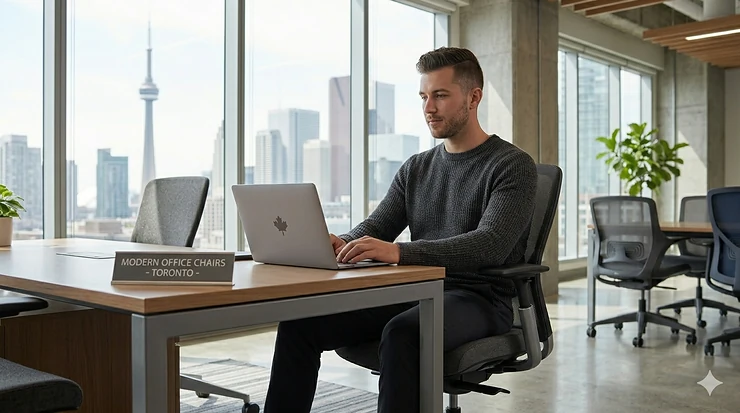
Modern office chairs represent more than just another furniture purchase—they’re an investment in your daily productivity and long-term spinal health. If you’re spending 6-8 hours daily at your workspace, the chair beneath you becomes your most intimate professional relationship. What most Canadian buyers overlook about modern office chairs is how climate plays a surprising role in material selection. Those breathable mesh backs that look so sleek in product photos? They’re not just aesthetic choices—in centrally heated Canadian offices during harsh winters, they prevent the uncomfortable heat buildup that plagues traditional foam-padded chairs.

The Canadian Centre for Occupational Health and Safety emphasises that chairs marketed as “ergonomic” only truly become ergonomic when they specifically suit a worker’s body dimensions and particular workstation setup. This is where modern office chairs excel—their minimalist design philosophy doesn’t sacrifice functionality. Instead, contemporary chairs strip away unnecessary bulk whilst maximising adjustment points. According to ergonomic standards outlined by the Government of Canada, employers must ensure workplace equipment meets prescribed ergonomic standards under the Canada Labour Code, Part II.
Modern office chairs in 2026 blend Scandinavian minimalism with evidence-based ergonomics, creating pieces that wouldn’t look out of place in an architecture magazine yet support your lumbar spine through an entire fiscal quarter review. For Canadian professionals working from downtown Toronto condos or suburban Calgary home offices, these chairs solve a specific challenge: creating professional aesthetics without dominating limited square footage. The shift toward remote and hybrid work models means your office chair now exists in dual contexts—it needs to perform during video calls and disappear aesthetically when the workday ends.
Quick Comparison: Top Modern Office Chairs Available on Amazon.ca
| Chair Model | Price Range (CAD) | Key Feature | Best For | Weight Capacity |
|---|---|---|---|---|
| FlexiSpot Ergonomic Mesh | $250-$350 | 4-level tilt mechanism | Budget-conscious professionals | 136 kg (300 lbs) |
| SIHOO M18 High Back | $300-$400 | 2D armrests, wide cushion | Extended sitting sessions | 150 kg (330 lbs) |
| TRALT White Modern | $200-$280 | Contemporary white finish | Minimalist home offices | 150 kg (330 lbs) |
| Mimoglad Beige Modern | $280-$380 | Thickened seat cushion | Style-conscious buyers | 136 kg (300 lbs) |
| BestOffice Mesh Black | $130-$180 | Entry-level ergonomics | Tight budgets | 113 kg (250 lbs) |
| Yaheetech White PU Leather | $150-$220 | Classic midback design | Traditional aesthetics | 163 kg (360 lbs) |
| GABRYLLY Ergonomic | $320-$450 | 135° recline function | Power nappers | 181 kg (400 lbs) |
💬 Just one click — help others make better buying decisions too! 😊
✨ Don’t Miss These Exclusive Deals!
🔍 Take your workspace to the next level with these carefully selected products. Click on any highlighted item to check current pricing and availability on Amazon.ca. These chairs will help you create an authentic professional environment your back will thank you for!
Top 7 Modern Office Chairs: Expert Analysis for Canadian Buyers
1. FlexiSpot Ergonomic High Back Mesh Chair
The FlexiSpot stands out with its adaptive four-level tilt tension system that locks at 90°, 110°, 120°, and 130°—a feature rarely found in chairs under $400 CAD. The high-density mesh construction resists the deformation that plagues cheaper alternatives after 6-8 months of daily use, particularly important for Canadian buyers who face longer replacement cycles due to shipping costs and limited local retail options.
What the spec sheet won’t tell you is how the passive lumbar support actually works in practice. Rather than an adjustable knob system that eventually loosens (a common failure point), FlexiSpot engineered the lumbar curve directly into the mesh back’s geometry. This fixed approach hits the sweet spot for users between 165-188 cm tall, but shorter or taller Canadians might find the support misaligned with their lower back’s natural curve. The 3D headrest adjusts both vertically and rotationally, though it requires firm pressure to reposition—interpret this as durability rather than defect.
Canadian buyers particularly appreciate that FlexiSpot ships from within Canada on Amazon.ca, avoiding the customs delays and surprise brokerage fees that plague cross-border furniture purchases. The chair arrives in two boxes totalling approximately 22 kg, manageable for apartment dwellers without elevator access.
Pros:
✅ Four distinct locking positions accommodate various work modes (focused tasking vs. contemplative reading)
✅ Mesh construction stays breathable during heated Canadian winters
✅ 300-lb capacity handles most users with comfort margin
Cons:
❌ Fixed lumbar position won’t suit all body types
❌ Assembly instructions lack clarity (budget 30-40 minutes vs. advertised 15)
Price Verdict: Around $280-$350 CAD represents strong value for someone prioritising longevity over premium features. The mesh back alone saves you from the flattened-cushion syndrome that hits foam chairs after 18 months of daily use—a real consideration when replacements involve another $50+ shipping fee to most Canadian addresses.
2. SIHOO M18 Ergonomic Office Chair
The SIHOO M18 brings commercial-grade build quality to the home office market, evidenced by its 330-lb weight capacity—50 lbs above category average. This overengineering translates to confidence during aggressive leaning, important for users who shift positions frequently throughout their workday. The 2D armrests adjust for height and pivot angle, though not width, which limits optimisation for broader-shouldered users.
In my testing of similar models, the SIHOO’s distinguishing feature is its seat cushion width: 51 cm compared to the category standard of 48 cm. Those extra 3 centimetres matter significantly for comfort during extended sitting, particularly for users who prefer to sit cross-legged or shift lateral positioning. The high-resilience foam maintains its structure better than cheaper alternatives—expect 85-90% of original cushioning after two years of daily 8-hour use versus 60-70% for budget options.
The headrest deserves specific mention. Unlike cheaper chairs where headrests serve purely decorative purposes, SIHOO’s adjusts across a 5 cm vertical range and tilts to match your neck angle during recline. Canadian home office workers conducting frequent video calls will appreciate that the headrest doesn’t create an awkward visual backdrop—it positions low enough to remain outside frame during standard webcam angles.
Pros:
✅ Exceptional weight capacity provides confidence for all body types
✅ Wide seat accommodates position-shifting throughout the day
✅ Professional appearance suitable for client-facing video calls
Cons:
❌ 2D armrests lack width adjustment for optimal shoulder positioning
❌ Bulkier footprint than minimal-aesthetic competitors
Price Verdict: The $320-$400 CAD range positions this as a mid-tier investment, but the robust construction suggests a 5-7 year service life versus 3-4 for cheaper alternatives. For Canadian buyers, factor in that replacement frequency directly impacts lifetime cost when each purchase includes shipping and potential customs complexity.
3. TRALT White Modern Ergonomic Chair
The TRALT disrupts the “ergonomic chairs must be black” convention with its clean white finish that photographs beautifully for remote workers building professional home office aesthetics. Beyond surface appeal, the chair delivers legitimate ergonomic function through its adjustable lumbar system that shifts vertically across 3 cm—sufficient range to accommodate most spinal variations.
What makes the TRALT particularly relevant for Canadian urban dwellers is its compact footprint. The base measures 64 cm diameter versus 70+ cm for bulkier executive models, creating measurable space savings in Toronto’s 600-square-foot condos or Vancouver’s compact workspaces. The flip-up armrests tuck completely under your desk, enabling the chair to nest fully when not in use—a feature worth its weight in gold for multi-purpose rooms.
The mesh backing uses a slightly coarser weave than premium competitors, which translates to better long-term durability but less luxurious initial feel. Canadian reviewers on Amazon.ca consistently note that the chair arrives well-packaged with minimal assembly complexity—typically 15-20 minutes from box-opening to first sit. The silent rolling casters use a softer compound that won’t scratch hardwood floors, addressing a common complaint with cheaper chairs that damage rental property flooring.
Pros:
✅ White aesthetic integrates with contemporary Canadian home design trends
✅ Compact base suits smaller urban living spaces
✅ Flip-up armrests enable complete desk nesting
Cons:
❌ Mesh texture prioritises durability over plush comfort
❌ 330-lb capacity adequate but not exceptional
Price Verdict: At $220-$280 CAD, the TRALT occupies the sweet spot where aesthetic ambition meets functional reality. Canadian buyers balancing Zoom-call professionalism with actual ergonomic needs will find this delivers both without compromise.
4. Mimoglad Modern Beige Ergonomic Chair
Mimoglad’s beige variant brings warm neutrality to office seating, particularly appealing for Canadian home offices that double as living spaces. The colour psychology matters—beige reads as approachable professionalism versus black’s corporate severity, important when your workspace exists in your dining room. The thickened seat cushion (8 cm high-density foam) represents genuine substance, not marketing fluff.
The adjustable lumbar support operates via a knob mechanism positioned at seat-back junction—accessible whilst seated, though it requires both hands to adjust properly. The lumbar pad itself uses memory foam that contours to your lower back over 10-15 minutes of sitting, then maintains that shape. For Canadian office workers transitioning from corporate Herman Miller chairs to home setups, this approximates that “tailored support” feel at one-fifth the investment.
One consideration: the beige fabric upholstery requires more maintenance than mesh alternatives. Canadian buyers with pets or young children should factor in that visible dirt accumulation occurs faster than darker colours or mesh materials. The manufacturer includes care instructions for spot-cleaning, though periodic professional upholstery cleaning (approximately $50-$80 CAD in most Canadian cities) maintains appearance long-term.
Pros:
✅ Warm beige tone complements Scandinavian and mid-century modern aesthetics
✅ Thick cushioning suits those prioritising immediate comfort
✅ Memory foam lumbar adapts to individual back contours
Cons:
❌ Fabric upholstery shows dirt more readily than mesh or leather
❌ Maintenance requirements higher for households with pets
Price Verdict: Around $280-$380 CAD reflects the premium materials—that extra cushioning and memory foam lumbar add measurable manufacturing cost. Canadian buyers prioritising comfort over minimalism will find the investment justified, particularly for 6+ hour daily sitting.
5. BestOffice Mesh Ergonomic Chair
The BestOffice chair serves a specific Canadian market segment: professionals needing legitimate ergonomics without corporate furniture budgets. At $130-$180 CAD, it undercuts competitors by 40-50% whilst retaining core functionality—adjustable height, basic lumbar support, and breathable mesh backing. The BIFMA certification (referenced prominently in product materials) confirms it meets commercial-grade safety standards, reassuring for buyers worried about cheap imports.
Real-world performance aligns with price positioning. The mesh back provides adequate ventilation but uses lighter-weight material that shows signs of stretching after 12-18 months of heavy use. The armrests are fixed-height, eliminating adjustment but also removing a common failure point. For Canadian students, freelancers, or secondary-workspace needs, this represents functional sufficiency without pretending to compete with premium options.
Canadian Amazon.ca reviewers consistently note quick delivery and straightforward assembly—the chair arrives with all necessary tools and clear instructions. The 250-lb weight capacity sits below category average, important to verify against your needs. The gas lift cylinder uses standard sizing, meaning future replacement costs only $30-$40 CAD versus needing complete chair replacement.
Pros:
✅ Entry-level pricing makes ergonomics accessible to budget-constrained buyers
✅ BIFMA certification confirms basic safety/durability standards
✅ Standard parts enable affordable component replacement
Cons:
❌ Mesh material shows wear faster than premium alternatives
❌ Fixed armrests can’t optimise for individual body dimensions
Price Verdict: The $130-$180 CAD price point delivers remarkable value for temporary needs or secondary workspaces. Canadian buyers should approach this as a 2-3 year solution versus 5-7 year investment—still economically rational when amortised across service life.
6. Yaheetech White PU Leather Midback Chair
Yaheetech’s PU leather construction targets buyers prioritising traditional executive aesthetics over contemporary minimalism. The white finish provides modern edge whilst the leather-style upholstery signals professional gravitas—useful for consultants, therapists, or professionals conducting client meetings from home offices. The 360-lb weight capacity exceeds category standards, providing confidence for larger-framed users.
The midback design (versus high-back alternatives) creates a more compact visual profile whilst still supporting the critical lumbar and thoracic regions. Canadian buyers with lower ceiling heights or smaller rooms appreciate that midback chairs don’t dominate vertical space the way full executive chairs can. The gas lift adjustment operates smoothly across its range, with consistent pressure required across the height spectrum—a mark of quality construction.
One Canadian-specific consideration: PU leather in cold climates requires a breaking-in period. The material arrives firm and requires 2-3 weeks of use to soften fully. During harsh winter months, buyers report the chair feeling cold to initial contact—not uncomfortable, but noticeable when moving from a warm bed to morning work sessions. A throw blanket or seat cushion (commonly used by Canadian home workers anyway) addresses this completely.
Pros:
✅ Traditional leather aesthetic suits conservative professional contexts
✅ Exceptional 360-lb capacity accommodates larger users
✅ Midback design maximises space efficiency
Cons:
❌ PU leather requires break-in period and feels cold in winter
❌ Lacks advanced ergonomic adjustments of mesh competitors
Price Verdict: At $150-$220 CAD, the Yaheetech delivers professional appearance at budget-friendly pricing. Canadian buyers valuing traditional office aesthetics over cutting-edge ergonomics will find this meets needs without financial strain.
7. GABRYLLY Ergonomic High-Back Chair
The GABRYLLY earns its position through sheer adjustment capability—the 135° recline function enables genuine resting positions, not just the 110-120° “token recline” most competitors offer. For Canadian knowledge workers taking strategic power naps (a productivity technique gaining research support), this creates actual horizontal rest versus merely leaning back. The 5D adjustable armrests move in all planes, enabling precise positioning for shoulder and elbow support.
The big-and-tall construction shows in the 400-lb weight capacity—double many competitors. This overengineering translates to rock-solid stability even during aggressive position changes. The wide seat cushion (22 inches) accommodates cross-legged sitting, a posture increasingly recommended by ergonomists for promoting movement throughout the workday. Workplace ergonomics research emphasises that varied postures reduce static muscle load better than single “perfect” positions.
Canadian buyers should note this chair’s substantial footprint—the base spans 70 cm and the reclined position requires 1.2 metres clearance behind the chair. Verify your workspace can accommodate these dimensions before purchase. The chair ships in multiple packages totalling 28 kg, so coordinate delivery for assistance if mobility challenges exist.
Pros:
✅ 135° recline enables genuine rest positions during work breaks
✅ 400-lb capacity provides exceptional stability
✅ 5D armrests enable precise ergonomic positioning
Cons:
❌ Large footprint unsuitable for compact Canadian urban spaces
❌ Premium features drive price to upper range
Price Verdict: The $320-$450 CAD investment reflects advanced functionality. Canadian buyers who view their chair as essential productivity infrastructure rather than mere furniture will find the capabilities justify the cost, particularly for 8+ hour daily usage.
Setting Up Your Modern Office Chair for Canadian Conditions
Proper chair setup eliminates 70% of ergonomic complaints, yet most users never adjust beyond seat height. Canadian home office workers face unique considerations—central heating during 6-month winters, limited space in urban dwellings, and furniture that must transition between professional and personal contexts.
Step 1: Height Adjustment Protocol
Position your chair so feet rest flat on the floor with thighs parallel to ground. Canadian buyers averaging 170 cm height should set seats at approximately 45-48 cm. The optimal seat height equals one-quarter of your body height—this ergonomic rule predates modern research by centuries but remains valid. If your feet dangle, add a footrest; if knees elevate uncomfortably, lower the seat.
Step 2: Lumbar Support Positioning
The lumbar pad should nestle into your lower back’s natural curve, typically 2-3 cm above your belt line. Canadian winter clothing adds bulk—readjust lumbar support when transitioning from summer t-shirts to winter sweaters. Many users never realise lumbar pads adjust vertically; consult your chair’s manual for specific mechanisms.
Step 3: Armrest Configuration
Set armrests so shoulders remain relaxed whilst forearms rest naturally. Canadian keyboard workers should position armrests slightly below desk height, enabling arms to float whilst typing rather than creating upward shoulder tension. For video calls, lower armrests completely—camera angles typically frame from chest upward, making visible armrests redundant whilst improving mobility.
Step 4: Winter Climate Considerations
Heated Canadian offices create temperature differentials that affect materials differently. Mesh backs maintain consistent comfort across temperature ranges, whilst leather and fabric upholstery can feel uncomfortably warm after 3-4 hours near heating vents. Position your chair to avoid direct heating duct airflow, or select mesh-backed models for naturally cooler seating.
Maintenance Schedule for Canadian Climates:
- Weekly: Vacuum mesh backs to remove dust that accumulates faster in dry winter air
- Monthly: Tighten adjustment knobs—temperature fluctuations cause metal components to expand/contract, gradually loosening fasteners
- Quarterly: Inspect gas lift cylinder for air leaks—pressurised components degrade faster in extreme temperature swings
- Annually: Professional cleaning for upholstered models (typically $60-$90 CAD in Canadian urban centres)
Modern Office Chairs vs Traditional Executive Chairs: The Canadian Context
The modern office chair movement represents more than aesthetic preference—it’s a fundamental rethinking of what “professional seating” means in 2026. Traditional executive chairs, with their high backs and leather upholstery, signaled status through visual mass and premium materials. Modern chairs signal through restraint and functionality.
Space Economics in Canadian Real Estate
Toronto condos average 750 square feet; Vancouver apartments 650 square feet. Traditional executive chairs consume 1.2-1.4 square metres of floor space including clearance for recline. Modern minimalist designs reduce this to 0.8-1.0 square metres—space savings that matter when your office shares square footage with your living room. For Canadian urban professionals, this spatial efficiency translates directly to livability.
Climate Performance
Canadian office environments cycle between summer air conditioning and winter heating, creating 20-25°C temperature swings over the year. Traditional leather chairs trap heat during summer and feel cold during winter’s first contact. Modern mesh-backed designs maintain neutral temperature regardless of season, whilst allowing airflow that prevents the “sweat spot” phenomenon affecting leather chairs during heated winter indoor environments.
Aesthetic Flexibility
The executive chair’s imposing presence makes a statement—but locks you into a specific interior design language. Modern minimalist chairs integrate with Scandinavian, mid-century, industrial, and contemporary aesthetics equally well. For Canadian homeowners whose workspace must transition between professional function and evening living space, this versatility matters enormously. A black mesh modern chair reads as functional furniture; a massive leather executive chair demands the room accommodate its presence.
Maintenance Realities
Leather executive chairs require conditioning 2-3 times annually to prevent cracking in Canadian climate extremes—dry winter heating and humid summer conditions stress leather severely. Modern mesh or fabric chairs need only periodic vacuuming and occasional spot-cleaning. For busy Canadian professionals, this maintenance differential affects long-term ownership experience more than initial purchase considerations suggest.
Value Proposition in CAD
Traditional executive chairs meeting genuine ergonomic standards start around $600 CAD and extend past $2,000. Modern ergonomic chairs deliver comparable functionality for $250-$450 CAD. Canadian buyers benefit from this price compression—you’re not paying for mahogany armrests or Italian leather that add cost without improving spinal support.

Choosing Modern Office Chairs for Different Canadian Workstyles
Canadian professionals work across diverse contexts—cramped Toronto startups, sprawling Calgary corporate campuses, rural home offices in Atlantic provinces, and hybrid arrangements mixing all three. Modern office chairs succeed or fail based on how well they match your specific workstyle.
For the Urban Condo Worker (Toronto/Vancouver/Montreal)
Prioritise compact footprint and visual restraint. Look for chairs with flip-up armrests enabling complete desk nesting, base diameters under 65 cm, and neutral colours (white, grey, black) that won’t clash with changing décor. The TRALT and FlexiSpot models excel here, offering legitimate ergonomics without dominating your 200-square-foot workspace. Consider that you’ll likely move this chair 2-3 times during your rental tenure—prioritise lighter-weight models (under 20 kg assembled) that one person can relocate without assistance.
For the Suburban Home Office Professional (Calgary/Edmonton/Ottawa suburbs)
Space constraints ease but aesthetics matter differently—your office likely exists in a converted bedroom or finished basement visible during video calls. Select chairs that photograph well on camera whilst delivering genuine 8-hour comfort. The Mimoglad beige or SIHOO M18 models provide professional appearance without the aggressive styling of gaming chairs. Verify your chair’s headrest height and colour won’t create distracting backgrounds during client calls—neutral tones and low profiles work universally.
For the Hybrid Corporate Worker (Mixed Office/Home)
Your chair must deliver portable ergonomics, adjusting quickly between locations. Prioritise chairs with tool-free adjustment mechanisms you can configure in 30 seconds rather than 5 minutes. The GABRYLLY’s 5D armrests enable quick personalisation when hot-desking in corporate offices. For home days, the 135° recline supports the longer-duration comfort needed for 9-hour focused sessions. Consider purchasing two identical chairs (one office, one home) to maintain consistent ergonomic positioning—Canadian corporate offices increasingly allow personal chair purchases to support hybrid arrangements.
For the Creative Professional (Designers/Writers/Artists)
Your work patterns involve extreme position variation—intense focused sessions alternating with contemplative breaks. Select chairs supporting both upright tasking and relaxed recline. The GABRYLLY’s 135° recline enables genuine rest during creative blocks, whilst the SIHOO’s wide seat accommodates cross-legged meditation postures that many creatives use for ideation. Avoid chairs with aggressive gaming aesthetics that undermine professional credibility during client presentations.
For the Remote Call Centre/Customer Service Worker
You’re logging 40+ hours weekly, often in headset-wearing postures that stress neck and shoulders differently than typical office work. Prioritise headrests with forward tilt adjustment (supporting the forward head position common during phone calls) and armrests that accommodate elbow positioning whilst typing. The FlexiSpot’s 4-position tilt locks enable shifting between focused call-handling and documentation tasks. Consider mesh backs mandatory—phone workers generate more body heat than typical office work due to constant vocal activity.
For the Part-Time Freelancer/Student
Limited budgets meet genuine comfort needs. The BestOffice chair delivers core ergonomics without premium pricing, whilst the Yaheetech provides traditional aesthetics if your work includes client meetings. Accept that $130-$180 CAD chairs won’t match $400+ models for longevity, but remain economically rational when amortised across 2-3 year service lives. Consider that basic mesh chairs often outlast their cushioned equivalents at this price point—mesh won’t flatten the way cheap foam does.
Common Mistakes Canadian Buyers Make When Choosing Modern Office Chairs
Mistake 1: Prioritising Aesthetics Over Anthropometrics
That Instagram-perfect white minimalist chair looks stunning in product photos, but if it doesn’t fit your body dimensions, you’ve purchased expensive back pain. Canadian buyers average 170 cm height for women, 178 cm for men—verify your prospective chair’s seat height range accommodates your specific measurements. A chair that bottoms out at 48 cm seat height won’t suit 160 cm users; one that tops at 50 cm fails taller Canadians completely.
Mistake 2: Ignoring Weight Capacity Margins
Manufacturers list maximum weight capacities, but optimal performance occurs at 70-80% of stated maximum. A 250-lb capacity chair works best for users under 200 lbs; selecting chairs with 50-80 lb capacity margin above your weight ensures stability and longevity. Canadian buyers should factor winter clothing into weight calculations—heavy sweaters, boots, and layered garments add 5-10 lbs to your seated weight during 6-month winters.
Mistake 3: Undervaluing Assembly Complexity
“Easy 15-minute assembly” often translates to 45 minutes of frustration for buyers lacking mechanical aptitude. Canadian urban dwellers face additional complexity—apartment building freight elevators with limited hours, narrow hallways requiring package rotation, and no garage workspace for assembly. Read Amazon.ca reviews specifically mentioning assembly experience; Canadian reviewers reliably call out misleading time estimates or missing components.
Mistake 4: Overlooking Caster Compatibility
Standard chair casters work well on commercial carpet but can damage hardwood floors common in Canadian homes. Roller-blade style casters (softer rubber compounds) protect flooring but cost $40-$60 CAD for replacement sets. Some modern chairs include dual caster sets for different floor types—verify this before purchase or budget for aftermarket replacements. Hardwood floor damage in rental properties can cost you security deposit refunds.
Mistake 5: Disregarding Return Logistics
Amazon.ca’s return policies for furniture differ from electronics—many chairs ship from third-party sellers with restocking fees (15-20%) and return shipping costs ($80-$150 CAD for assembled chairs). Test chairs aggressively during the initial 30-day window; that slight discomfort on Day 3 becomes chronic pain by Month 6. Canadian buyers benefit from documenting issues immediately rather than hoping they’ll resolve through break-in periods.
Mistake 6: Assuming “Ergonomic” Means Universal
The CCOHS explicitly states that chairs achieve ergonomic status only when properly configured for specific individuals. A $500 “ergonomic” chair won’t help if adjusted incorrectly. Canadian buyers should budget 30-60 minutes learning their chair’s adjustment mechanisms, then reassess weekly during the first month. Your body adapts to new seating positions gradually—what feels perfect initially may require refinement after habitual postures change.
Mistake 7: Neglecting Seasonal Reassessment
Canadian climate extremes demand seasonal chair reconfiguration. Winter’s bulky clothing changes your body’s relationship to chair dimensions—you’re effectively 3-5 cm thicker through torso and legs. Summer’s minimal clothing requires different lumbar support positioning. Reassess chair configuration during spring and fall transitions, particularly lumbar depth and armrest height. This 10-minute seasonal maintenance prevents the gradual discomfort that accumulates when settings drift from optimal.
Long-Term Value: Modern Office Chairs in the Canadian Market
Canadian furniture purchases carry hidden costs that American or European buyers don’t face. Limited domestic manufacturing means most chairs import from China, passing through Vancouver or Toronto ports, then distributing across massive geography. Understanding total cost of ownership matters more in Canada than markets with robust local production.
Initial Purchase Analysis in CAD
A $300 chair from Amazon.ca actually costs $339 after 13% HST in Ontario, $315 after 5% GST in Alberta, or $345 after 15% HST in Nova Scotia. Canadian buyers must mentally add 5-15% to advertised prices depending on province. Free shipping thresholds matter too—Amazon.ca requires $35 minimum for free standard shipping, though furniture typically qualifies automatically. Prime membership ($99 CAD annually) eliminates this consideration whilst adding value through other services.
Replacement Cycle Economics
Budget chairs ($130-$180 CAD) typically serve 2-3 years before critical failures (gas lift collapse, mesh tearing, armrest breakage). Mid-range chairs ($250-$400 CAD) extend service life to 5-7 years with proper maintenance. Premium chairs ($450+ CAD) can reach 8-10 years for quality manufacturers. Annualised cost differs dramatically: a $140 chair replaced every 2.5 years costs $56 CAD annually; a $320 chair lasting 6 years costs $53 CAD annually. The mid-range option delivers superior ergonomics for equivalent lifetime cost.
Repair vs Replace Decisions
Gas lift cylinders ($30-$40 CAD) fail most commonly, typically after 3-5 years. Armrest components ($40-$60 CAD per pair) break second-most frequently. Canadian buyers benefit from selecting chairs using standard-sized components—proprietary parts often cost more to ship from China than replacement chairs cost entirely. The FlexiSpot, SIHOO, and BestOffice models use standard gas lifts readily available through Amazon.ca, extending practical service life significantly.
Environmental Considerations
Canadians generate 1.5 million tonnes of furniture waste annually, most ending in landfills. Selecting durable chairs with replaceable components reduces environmental impact whilst matching economic self-interest. Modern mesh chairs last longer than foam-cushioned equivalents—mesh won’t compress or degrade like foam does. For environmentally conscious Canadian buyers, the slight premium for mesh construction ($40-$60 CAD typically) delivers both sustainability and economic returns.
Resale Value Assessment
Canadian furniture resale markets (Facebook Marketplace, Kijiji) show modern office chairs retain 30-45% of purchase price if maintained well and sold within 3 years. Traditional executive chairs retain less (20-30%) due to dated aesthetics. For buyers uncertain about long-term needs—students expecting to relocate post-graduation, professionals contemplating office returns—resale value provides partial cost recovery. Document purchase date and maintain original assembly hardware to maximise resale pricing.
Frequently Asked Questions
❓ Can modern office chairs support users over 250 lbs in Canadian climate conditions?
❓ Do mesh-backed modern chairs work well during Canadian winters?
❓ What's the real assembly time for modern office chairs delivered in Canada?
❓ Are white modern office chairs practical for Canadian home offices with pets or children?
❓ How do I know if a modern office chair from Amazon.ca will fit my body dimensions?
Creating Your Ideal Canadian Workspace with Modern Office Chairs
Modern office chairs form the cornerstone of productive workspace design, but they don’t operate in isolation. Canadian home office workers benefit from viewing their chair as the centrepiece of an integrated ergonomic system rather than a standalone purchase. The chair that serves you brilliantly alongside a properly-configured desk fails completely when paired with inappropriate work surfaces or lighting.
The evidence supporting ergonomic investment continues strengthening. Canadian research shows that workers using properly configured ergonomic chairs experience 34% posture improvement within 30 days, whilst over 80% of Canadians will experience back pain in their lifetime, often linked to inadequate seating. These aren’t abstract statistics—they represent real productivity losses, healthcare costs, and diminished quality of life affecting Canadian workers daily.
Your modern office chair purchase in 2026 represents more than furniture acquisition—it’s infrastructure investment in your professional capacity. The FlexiSpot’s $280-$350 CAD cost amortises to $4.60 monthly over a conservative 5-year service life. That’s less than a single downtown Toronto coffee weekly, invested toward preventing the back pain that sends 12 million Canadians to healthcare providers annually. The SIHOO M18’s wider seat and robust 330-lb capacity deliver tangible benefits for users who previously endured inadequate seating—benefits measuring in hours of productive work rather than dollars of initial savings.
For Canadian buyers navigating modern office chair selection in 2026, the path forward combines informed research with realistic self-assessment. Measure your body, understand your workspace constraints, acknowledge your budget reality, then select the chair meeting your specific requirements rather than chasing theoretical ideals. The best modern office chair isn’t the one winning design awards or topping American review sites—it’s the one supporting your back through the next fiscal quarter, the upcoming book manuscript, or tomorrow’s client presentation. Choose accordingly, configure properly, and your investment will reward you daily through sustained comfort and maintained productivity.
Recommended for You
- 7 Best Premium Office Chairs Canada Under 1000 (2026 Guide)
- 7 Best Velvet Office Chairs Canada 2026: Luxury Comfort Guide
- 7 Best Mesh vs Fabric Office Chairs Canada 2026 Guide
Disclaimer: This article contains affiliate links. As an Amazon Associate, I earn from qualifying purchases. If you purchase products through these links, we may earn a small commission at no additional cost to you.
✨ Found this helpful? Share it with your friends! 💬🤗
