
In This Article
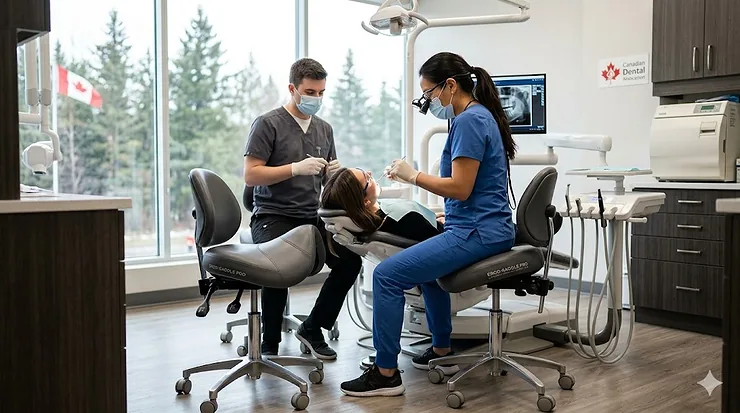
Let’s be blunt: if you’re still perching on a flat-seated stool at the end of a twelve-hour shift, your back already knows it. Saddle chairs for dentists aren’t a luxury — they’re a career-preservation tool, and Canadian dental professionals are finally catching on in a big way.
Here’s the uncomfortable truth that no dental school brochure mentions: around 65% of dental professionals experience persistent back pain, and that number has barely budged over the past five decades. You can be the most technically gifted dentist in your province, but if your seating posture is quietly destroying your lumbar spine, your career longevity is measured in years, not decades.
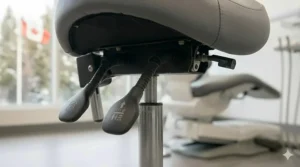
A saddle chair for dentists works on a brilliantly simple principle. According to Wikipedia’s overview of saddle chair design, users sit 20–30 cm higher than on a conventional chair, which places the hips and knees at roughly a 135° angle rather than the compressed 90° angle of a standard flat seat. That open hip angle tilts the pelvis forward naturally, restoring the spine’s three natural curves without you having to think about it. Think of it as “supported standing” — you’re upright and mobile, but not fatigued from being on your feet all day.
For Canadian dental professionals, there’s an additional layer to consider. Clinical workdays in busy practices from Halifax to Vancouver can stretch well beyond eight hours. Commuting in Canadian winters, followed by a full day of forward-leaning, precision work is a recipe for compounded postural stress. Investing in the right adjustable dental seating is, quite literally, an investment in your ability to keep practising.
In this guide, I’ve researched seven real products available on Amazon.ca (in CAD), compared their features against what your body actually needs, and given you the honest expert commentary you won’t find on any product page. Let’s get into it.
Quick Comparison Table: Top 7 Saddle Chairs for Dentists in Canada
| Product | Type | Height Range | Weight Capacity | Best For | Est. Price (CAD) |
|---|---|---|---|---|---|
| Viviange Ergonomic Dental Saddle Stool | Saddle w/ Backrest | 48–62 cm (19–24.4″) | ~136 kg (300 lbs) | Hygienists wanting back support | $150–$220 |
| HNKastela Rolling Saddle Chair w/ Back Support | Saddle w/ Backrest | Adjustable hydraulic | ~136 kg (300 lbs) | Estheticians & dental hygienists | $120–$180 |
| Ailyful Ergonomic Split-Seat Saddle Stool | Split saddle w/ Backrest | Adjustable | ~220 kg (485 lbs) | Heavy-duty clinical use | $160–$240 |
| VEVOR Medical Dental Stool w/ 360° Armrest | Dental assistant style | Adjustable | ~136 kg (300 lbs) | Dental assistants requiring armrest | $180–$260 |
| LIMKOMES Saddle Stool 3-Way Function | Saddle w/ Backrest | Adjustable hydraulic | ~181 kg (400 lbs) | General clinical & hygienist use | $130–$200 |
| BONEW Global Dental Saddle Chair (Deluxe) | Classic saddle | Adjustable | ~136 kg (300 lbs) | Budget-conscious practitioners | $100–$160 |
| PERCH Rolling Dental Stool w/ Procedure Arm | Traditional dental | 57–71 cm (22.5–28″) | Standard clinical | Dentists needing procedure arm | $220–$320 |
All prices are approximate CAD ranges at time of research. Check Amazon.ca for current pricing as prices change frequently.
What’s immediately clear from this table is the wide spectrum of value on offer. The PERCH and VEVOR models command a premium, but they bring clinical-grade features that justify the cost difference for full-time practitioners. Budget buyers shouldn’t automatically default to the cheapest option — for saddle chairs, seat quality and gas cylinder durability are the features that actually determine long-term value. Spending $130 CAD on a stool that degrades in six months is a worse deal than spending $200 on one that lasts five years.
💬 Just one click — help others make better buying decisions too! 😊
✨ Don’t Miss These Exclusive Deals!
🔍 Take your clinical workspace seating to the next level with these carefully selected products. Click on any highlighted product name to check current pricing and availability on Amazon.ca. These ergonomic tools will help you work pain-free and serve patients better for years to come!
Top 7 Saddle Chairs for Dentists: Expert Analysis
1. Viviange Ergonomic Dental Saddle Stool with Back Support
If you’re a hygienist who spends six or more hours in operatory procedures and needs lumbar support without sacrificing mobility, the Viviange Ergonomic Dental Saddle Stool is your most compelling starting point. It’s specifically engineered for dental professionals — not repurposed from a salon or tattoo-studio line — and that intentional focus shows in the details.
The seat height adjusts from approximately 48 to 62 cm (19 to 24.4″), which accommodates most adult dental professionals and aligns well with standard Canadian operatory heights. The microfiber leather upholstery is both breathable and easy to wipe down, which matters enormously in a clinical environment where cross-contamination standards are non-negotiable. The smooth-rolling casters glide across both vinyl and tile flooring — the two most common floor types in Canadian dental offices — without the shrill squeaking you get from cheaper nylon wheels on a cold, hard surface.
What most buyers overlook about this model is the backrest angle. It’s not a rigid lumbar board — it tilts to accommodate different procedural positions. During upper-arch work, you’ll naturally lean forward slightly, and the backrest adjusts rather than fights you. For a Canadian hygienist dealing with a busy mixed-practitioner schedule, that adaptability is worth paying attention to.
Canadian reviewers on Amazon.ca have noted easy assembly and consistent durability after daily professional use. Available on Amazon.ca — Prime-eligible shipping available.
✅ Ergonomic saddle design promotes neutral pelvic tilt
✅ Easy-clean microfiber leather suitable for clinical environments
✅ Smooth casters work on tile and vinyl flooring
❌ Seat width may feel narrow for broader hip frames
❌ Limited colour options compared to salon-grade alternatives
Price range: Around $150–$220 CAD — solid mid-range value for a dental-specific build.
2. HNKastela Rolling Saddle Chair with Back Support
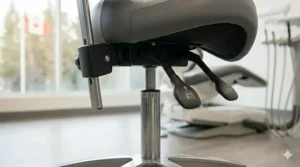
The HNKastela Rolling Saddle Chair has built an impressive following among dental hygienists and estheticians precisely because it doesn’t try to be everything — it focuses on the fundamentals and executes them well. With over 20 years of seating manufacturing experience behind the brand, HNKastela brings genuine product maturity to a market crowded with one-season wonders.
The seat’s extra-thick cushioning is the standout feature here. Most saddle stools suffer from a common flaw: the seat pan is too firm, and after two hours, you’re unconsciously shifting your weight in ways that undo all the ergonomic benefit. HNKastela’s thicker foam delays that fatigue significantly. The hydraulic lift is smooth and responsive — you can adjust mid-procedure without a jerky descent that startles a patient.
In terms of practical fit for Canadian clinical settings, the compact footprint of this chair is a genuine advantage. Urban dental offices in Toronto, Vancouver, or Montreal often operate with tighter operatory layouts than American practices, and a chair that doesn’t eat floor space is appreciated by both practitioners and practice managers. The 360° swivel is fluid, and the locking casters — a feature absent from many budget stools — let you park the chair securely when positioning matters.
Available on Amazon.ca — check for Prime eligibility.
✅ Extra-thick seat cushion reduces fatigue in long procedures
✅ Locking casters for positional stability
✅ Compact footprint suits smaller Canadian operatory layouts
❌ Backrest height may not suit very tall practitioners
❌ Assembly instructions could be clearer
Price range: Around $120–$180 CAD — excellent value-per-comfort ratio.
3. Ailyful Ergonomic Split-Seat Saddle Stool with Backrest
Here’s where things get genuinely interesting for the anatomy-aware buyer. The Ailyful Ergonomic Split-Seat Saddle Stool features a divided seat design — two independent cushion halves that move with the natural motion of your sit bones. For practitioners who’ve tried traditional saddle stools and found them uncomfortable in the perineal region (a genuinely common complaint, particularly among male practitioners), the split seat is a revelation.
The 485 lbs (approximately 220 kg) weight capacity is the highest in this roundup and speaks to the structural quality of the base and gas cylinder. The 12° tilt adjustment on the seat pan lets you find the precise pelvic angle that works for your body type — something a fixed-angle saddle simply cannot offer. This matters because peer-reviewed research published in PLOS ONE confirms that saddle seats significantly outperform conventional seats in promoting neutral lumbar posture in dental students, but the benefit depends on proper seat angle relative to the individual user’s pelvic geometry.
For Canadian practitioners dealing with the physical demands of a high-volume practice — say, a downtown Calgary clinic running back-to-back appointments — the Ailyful’s durability-first construction is reassuring. The 360° swivel is precise, and the casters handle the transition between different flooring materials without catching.
Available on Amazon.ca — check current availability and shipping to your province.
✅ Split seat eliminates perineal pressure — a major advantage over traditional saddles
✅ 485 lbs / 220 kg capacity — highest structural rating in this roundup
✅ 12° tilt adjustment allows precise pelvic angle customisation
❌ Wider split design requires some adjustment in narrow operatory spaces
❌ Higher price point than basic single-seat saddle options
Price range: Around $160–$240 CAD — premium justification is real for longer procedures.
4. VEVOR Medical Dental Stool with 360° Rotation Armrest
The VEVOR Medical Dental Stool takes a different architectural approach: instead of a pure saddle seat, it incorporates rotating armrests that give dental assistants and hygienists lateral arm support during extended procedures. If you’re spending significant time on microscope-assisted work or fine-instrument procedures where arm fatigue is a specific concern, this distinction matters enormously.
VEVOR is a well-established brand in professional and home improvement contexts, and their medical stool reflects that institutional experience. The PU leather upholstery is heavy-duty — genuinely more resistant to clinical cleaning agents than the microfiber options on cheaper competitors. The rotating armrests swing out of the way when not in use, so they don’t interfere with patient access. The height-adjustable base accommodates a wide range of operator heights.
What I particularly appreciate about this model is the 360° armrest rotation. Most dental assistant chairs lock the armrests at fixed positions, which means you’re fighting the chair every time your patient’s position changes. The VEVOR solves this elegantly. For a Canadian dental assistant in a multi-chair practice who rotates between operating positions throughout the day, this adaptability translates to less shoulder fatigue by end of shift.
Available on Amazon.ca — check current Prime shipping eligibility.
✅ 360° rotating armrests for genuine clinical arm support
✅ Heavy-duty PU leather withstands clinical disinfectants
✅ Established brand with reliable customer support
❌ Armrest mechanism adds bulk — not ideal for very tight operatory spaces
❌ Armrest-equipped design is overkill for purely saddle-seat advocates
Price range: Around $180–$260 CAD — the armrest engineering justifies the premium.
5. LIMKOMES Medical Dental Assistant Chair (3-Way Function)
The LIMKOMES Medical Dental Assistant Chair occupies a smart middle position in the market: more feature-rich than entry-level saddle stools, but without the premium pricing of full-featured clinical systems. The “3-way function” branding refers to the chair’s three adjustment dimensions — seat height, backrest height, and seat tilt — all accessible without tools and without interrupting a procedure.
LIMKOMES has specialised in dental seating for over 20 years, and that focus shows in the seat geometry. The saddle shape encourages that 135–140° hip-knee angle that research from multiple peer-reviewed studies consistently links to reduced lumbar muscle activation compared to flat-seat alternatives. The 400 lbs (approximately 181 kg) weight capacity covers the full range of adult practitioners, and the aluminium five-star base is meaningfully more durable than the plastic bases found on budget competitors.
For a Canadian dental hygienist in a suburban practice — say, an Oakville or Surrey clinic with a mixed patient load — the LIMKOMES offers practical value. The accessories ecosystem is also worth noting: replacement wheels, casters, and gas lift cylinders are available through the LIMKOMES store, which means you’re not buying a disposable chair. In a country where shipping delays can stretch into weeks for remote areas, a chair you can maintain yourself is a genuine advantage.
Available on Amazon.ca — verify current stock and provincial shipping.
✅ Three independent adjustments without tools
✅ Replaceable components for long-term maintenance
✅ 181 kg capacity with durable aluminium base
❌ Saddle design without split seat may not suit all body types
❌ Backrest support is lighter than premium alternatives
Price range: Around $130–$200 CAD — outstanding value for the feature set.
6. BONEW Global Dental Saddle Chair (Deluxe, PU Leather)
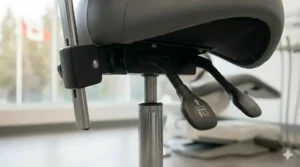
The BONEW Global Dental Saddle Chair Deluxe is the pick for Canadian dental professionals who want a genuine saddle-geometry chair without straying into mid-range pricing territory. It’s a classic, no-frills saddle design with PU leather upholstery and a straightforward hydraulic adjustment — and sometimes, uncomplicated execution of the core concept is exactly what you need.
The saddle shape is well-contoured for most body types, with enough depth in the seat pan to support the sit bones without forcing an uncomfortably wide hip abduction. PU leather is the right material call for a dental environment: it wipes clean quickly, doesn’t absorb aerosols, and won’t develop the unpleasant texture that fabric stools acquire over months of clinical use.
What most buyers overlook here is the BONEW’s suitability as a secondary chair. Many Canadian practices operate with a primary clinician chair and a secondary assistant position. Investing $200–$260 CAD on both positions doubles the budget; the BONEW makes the secondary position ergonomically sound at a fraction of the cost. It’s also a reasonable first saddle chair for a recent dental graduate starting their first associateship in Canada — a practical, lower-risk way to test whether saddle seating suits your workflow before committing to a higher investment.
Available on Amazon.ca — solid availability across Canada.
✅ Classic saddle geometry at an accessible price
✅ Easy-clean PU leather suitable for clinical environments
✅ Ideal as a secondary assistant chair or for new practitioners
❌ No backrest — may not suit all-day procedural use
❌ Fewer adjustment options than mid-range competitors
Price range: Around $100–$160 CAD — the most accessible entry point in this roundup.
7. PERCH Rolling Dental Stool with Procedure Arm & Foot Ring
The PERCH Rolling Dental Stool is the category authority for traditional dental assistant seating with a procedure arm — and it earns that status through engineering precision rather than marketing. If your workflow specifically requires a procedure arm to rest instruments or documentation materials during procedures, the PERCH is the product that’s been designed around that clinical need.
The procedure arm swings into position easily and locks securely, which is critical when you’re holding an instrument tray at consistent height through a forty-five-minute restoration. The foot ring is height-adjustable and stabilises your lower body — important for maintaining a centred seating position when reaching forward. The height range of approximately 57–71 cm (22.5–28″) accommodates bench-height workstations common in Canadian lab and sterilisation areas, not just standard chair-side positions.
What the spec sheet doesn’t tell you: PERCH chairs arrive partially pre-assembled and the instructions are genuinely clear — a small detail that saves thirty minutes of frustration on a Monday morning. The vinyl upholstery is available in multiple colours, which matters if your practice has specific colour-coding for sterilisation or infection control zones. The casters are specifically designed for carpet and hard-floor compatibility, which covers the range of flooring you’ll encounter in Canadian clinical and administrative areas.
Available on Amazon.ca — note that Canadian pricing typically runs slightly higher than US equivalent; however, you avoid cross-border shipping fees, customs delays, and any warranty complications.
✅ Integrated procedure arm — genuine clinical workflow benefit
✅ Adjustable foot ring for lower-body stability
✅ Dual-floor casters for carpet and hard surfaces
❌ Heavier and less mobile than pure saddle alternatives
❌ Procedure arm adds complexity for pure saddle-chair users
Price range: Around $220–$320 CAD — premium justified by procedure arm engineering and long-term clinical durability.
How to Choose Saddle Chairs for Dentists in Canada: A Step-by-Step Framework
Choosing the right adjustable dental seating isn’t about picking the most expensive option — it’s about matching the chair’s geometry to your body and your workflow. Here’s how to approach it logically.
1. Identify your primary procedure type. Are you primarily doing hygiene work (forward-leaning, sustained position), restorative procedures (frequent position changes), or administrative/lab work? Hygienists benefit most from saddle chairs with back support. Restorative dentists often prefer true saddle stools with maximum 360° mobility. Lab technicians want height adjustability above all else.
2. Measure your operatory height and work surface. A saddle chair raises your seated height by 15–20 cm compared to a traditional stool. If your operatory chair and counter heights are fixed, verify that a saddle seating position still places your elbows at a comfortable working height. Most Canadian operatories built after 2010 have adjustable components, but older practices may require a work surface adjustment.
3. Consider your body geometry honestly. Broader hips benefit from wider saddle profiles or split-seat designs like the Ailyful. Narrower frames often find standard saddle widths more comfortable. If you’ve tried a saddle chair before and found it uncomfortable specifically in the perineal region, a split-seat model isn’t just a preference — it’s a physiological necessity.
4. Decide on backrest requirements. True saddle purists argue that a backrest undermines the active postural benefit of saddle seating. Practically speaking, for a dental hygienist in an eight-hour clinical day, the fatigue reduction from intermittent backrest use outweighs any theoretical postural compromise. Choose a backrest if you’ll use it; skip it if you’re committed to the pure saddle approach.
5. Account for Canadian shipping realities. If you’re in a remote or northern community, verify shipping timelines before purchasing. Amazon Prime generally offers reliable two-day delivery to major urban centres across Canada, but rural addresses in Manitoba, Saskatchewan, or northern Ontario and BC may experience longer lead times. Factor this into your timeline if you’re replacing a failing chair.
6. Check the weight capacity against your actual weight plus a safety margin. Choose a chair rated for at least 20–25 kg above your body weight. Gas cylinders are the first component to fail when consistently used at maximum capacity, and replacements — even available ones — add cost and downtime.
7. Budget realistically in CAD. The medical-grade ergonomics sweet spot on Amazon.ca sits between $150 and $250 CAD. Below $100 CAD, you’re buying a chair that may not survive a year of daily clinical use. Above $300 CAD, you’re entering territory where additional research — including consulting your provincial dental association’s recommended suppliers — may yield better clinical-specific alternatives not available on Amazon.ca.
Real-World Scenarios: Matching the Right Chair to the Right Canadian Practitioner
Profile 1: Maya, Dental Hygienist in a Busy Toronto Clinic
Maya is a registered dental hygienist at a four-operatory practice in Scarborough. She sees twelve to fifteen patients daily, handles mostly hygiene appointments lasting 45–60 minutes each, and has been experiencing lower back tension that starts around hour five of her shift. She wants a saddle chair but worries about the learning curve.
Best match: The Viviange Ergonomic Dental Saddle Stool at around $150–$220 CAD. The built-in backrest gives her a transitional support option while her core muscles adapt to saddle seating — a process that typically takes two to four weeks. The dental-specific design means the seat geometry is already calibrated for forward-leaning hygiene positions, reducing that adjustment period. Prime shipping gets it to her practice in Scarborough within days.
Profile 2: Dr. Ramesh, Associate Dentist in a Suburban Ottawa Practice
Dr. Ramesh is two years post-graduation and starting his first full-time associateship. He’s budget-conscious and wants to invest wisely without overcommitting on his first ergonomic upgrade. He does a mix of restorative and preventive work and his operatory is tight — approximately 3 by 3.5 metres.
Best match: The BONEW Global Dental Saddle Chair Deluxe at $100–$160 CAD as a starting point, or the LIMKOMES 3-Way Function at $130–$200 CAD if he wants adjustment flexibility. Both have compact footprints suited to smaller operatories. If saddle seating works well for him after 90 days, he can upgrade to the Ailyful split-seat for a better long-term fit.
Profile 3: Jennifer, Practice Owner in Rural Nova Scotia
Jennifer owns a mixed-practice in Truro, NS, and needs a chair that can handle high daily volume, is durable enough to last several years without requiring parts unavailable in the Maritimes, and can ship reliably to her area. She sees both patients and manages the administrative side of the practice.
Best match: The LIMKOMES 3-Way Function at $130–$200 CAD, specifically because of the brand’s accessible replacement parts ecosystem. When her gas cylinder eventually fails (all hydraulic chairs will at some point), LIMKOMES replacement cylinders are available via Amazon.ca without a prolonged wait. She can also keep a spare in the supply room — a practical consideration that urban practitioners often overlook.
Saddle Chairs vs. Traditional Dental Stools: What the Research Actually Says
The debate between saddle chairs and traditional flat-seated dental stools has been thoroughly explored in clinical literature, and the findings are nuanced rather than black-and-white. Here’s what you actually need to know.
A peer-reviewed meta-analysis published in PLOS ONE found that results from studies conducted with dental students significantly favour saddle seats over conventional seats for posture quality. Specifically, the saddle seat’s tilted position promotes lumbar lordosis — the natural inward curve of the lower back — which is compressed and lost on a flat stool.
Research published in the International Journal of Dental Hygiene and reviewed in a 2020 systematic review from MDPI’s environmental health journal also points to ergonomic saddle seats as a meaningful intervention in reducing musculoskeletal disorder risk in dental professionals, particularly when combined with other ergonomic tools like loupes.
However, it’s important to be honest: the transition to saddle seating is not effortless. Many practitioners experience initial discomfort in the first one to three weeks as their hip flexors and core muscles adapt. This is a conditioning phase, not an indication that the chair is wrong for you. The spec sheet won’t tell you this, but the adjustment period is the most common reason practitioners abandon saddle chairs prematurely and return to flat stools.
The practical verdict: for Canadian dental professionals who spend more than four hours per day in seated clinical positions, a well-fitted saddle chair offers measurable advantages in spinal alignment and long-term musculoskeletal health. The investment in the right healthcare professional furniture now is significantly cheaper — in CAD and in quality of life — than extended physiotherapy or career interruption from chronic back injury later.
| Feature | Saddle Chair | Traditional Flat Stool |
|---|---|---|
| Hip-knee angle | 135° (optimal) | 90° (compressed) |
| Lumbar curve support | Natural / maintained | Often lost |
| Core muscle activation | Increased (active sitting) | Reduced (passive) |
| Initial comfort | Learning curve 2–4 weeks | Immediately familiar |
| Long-term back health | Better (research-supported) | Higher MSD risk |
| Mobility / 360° access | Excellent | Good |
| Best for | Hygienists, long procedures | Short procedures, transitions |
The data here is compelling, but the human factor matters: a saddle chair you don’t use because it feels uncomfortable is worse than a traditional stool you actually use correctly. The transition investment pays off — just allow adequate time.
Common Mistakes When Buying Saddle Chairs for Dentists in Canada
Avoiding these pitfalls saves you money and returns headaches.
Mistake #1: Prioritising seat appearance over seat geometry. A saddle chair that photographs beautifully but has a seat pan that’s too narrow for your pelvis will cause inner-thigh pressure and hip discomfort within an hour. Always check the seat width measurement against your own sit-bone width — a rough guide is that most practitioners with narrower frames suit seats under 33 cm (13″) wide, while broader frames benefit from 36 cm (14″) or wider.
Mistake #2: Ignoring the gas cylinder quality. This is the most common failure point in budget saddle stools. A cheap gas cylinder degrades under daily clinical use within 12–18 months. Look for chairs that mention Class 4 gas cylinders, or that have replacement cylinders available from the same brand.
Mistake #3: Buying based on salon reviews rather than clinical reviews. Many saddle stools cross-market to salons, tattoo artists, and offices. A stylist sitting for two-hour appointments twice a day has very different seating demands than a hygienist working six hours in forward-leaning positions. Prioritise reviews from actual dental or medical professionals when evaluating clinical workspace seating.
Mistake #4: Forgetting to check Amazon.ca (not Amazon.com) availability. Several popular saddle chair models visible in American reviews don’t ship to Canada, or arrive with significant duties and cross-border delays. Always search directly on Amazon.ca, and check whether the product is fulfilled by Amazon Canada or a third-party seller with limited Canadian shipping.
Mistake #5: Skipping the weight capacity math. A stool rated for exactly your body weight will degrade faster than one with a comfortable capacity margin. Buy at least 20–25 kg above your current weight. Higher-capacity models also tend to have more robust base and caster construction across the board.
Mistake #6: Buying without considering your work surface height. Saddle seating raises your sitting height considerably. If you can’t adjust your operatory counter or delivery unit height, you may find yourself in an awkward reaching position that negates the ergonomic benefit. Check your current seated work surface height before purchasing.
Long-Term Cost & Maintenance of Dental Saddle Chairs in Canada
The total cost of ownership of a saddle chair is not just the purchase price. Here’s how to think about it in CAD over a five-year horizon.
A mid-range saddle chair purchased for $180–$220 CAD with good gas cylinder quality and replaceable casters should last 4–6 years in daily clinical use. At replacement cost of around $200 CAD every five years, that’s roughly $40 CAD per year — less than a single physiotherapy appointment in most Canadian provinces.
Compare that to the indirect costs of not investing in proper healthcare professional furniture: physiotherapy for lower back pain in Canada costs $80–$150 CAD per session, with most musculoskeletal treatment plans running 8–12 sessions. A single cycle of physiotherapy costs more than the best chair in this roundup.
Maintenance tips to extend chair life in a Canadian clinical setting:
✅ Wipe down with dental-grade disinfectants, but avoid bleach-based products on PU leather — they degrade the material over time. Check the manufacturer’s cleaning guidelines, especially if your practice follows specific Ontario RCDSO or BC College of Dental Surgeons infection control standards.
✅ Check caster integrity every six months. Canadian tile and vinyl flooring can develop microscopic chips that accelerate caster wear. Replace worn casters before they start scratching floors.
✅ Lubricate the swivel mechanism annually with a silicone-based lubricant (not WD-40, which attracts dust). A smooth swivel is critical in clinical settings where you’re repositioning frequently.
✅ Replace the gas cylinder proactively at the first sign of slow sinking. A cylinder that drops while you’re in a procedure is a safety and ergonomic hazard. LIMKOMES, LIMKOMES, and several other brands sell replacement cylinders on Amazon.ca.
For Canadian dental practices writing off equipment costs, saddle chairs typically qualify as a business expense under CRA’s capital cost allowance guidelines. Consult your accountant — a $200 chair amortised over three years is a very manageable business cost, and it’s deductible.
Features That Actually Matter in Clinical Workspace Seating (And Those That Don’t)
Let’s cut through the marketing noise.
Features That Genuinely Matter:
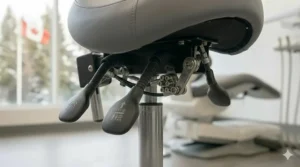
Seat tilt adjustment — The ability to fine-tune your pelvic angle is the single most impactful feature for personalising the ergonomic benefit. A fixed-angle seat cannot accommodate the variation between practitioners.
Gas cylinder quality and replaceability — Already covered above. Non-negotiable.
Caster type and floor compatibility — Dual-surface casters that handle both hard floors and any carpeted areas in your practice are worth the marginal cost difference.
Seat material durability and cleanability — PU leather and microfiber leather both work in clinical settings. Fabric does not. If you’re in a practice with strict infection control protocols (required under Health Canada and provincial dental regulatory guidelines), check that the upholstery is rated for dental disinfectants.
Weight capacity margin — Already addressed. Matters for longevity.
Features That Are Often Overstated:
Colour selection — Nice to have for practice aesthetics, but has zero ergonomic impact.
Armrests on a pure saddle chair — Armrests on a saddle chair can actually interfere with the open hip angle that makes saddle seating work. Armrests are appropriate on dental assistant chairs (like the VEVOR) where a different seating geometry is in play.
Excessive cushion thickness on a saddle stool — Counter-intuitively, an overly soft cushion on a saddle stool undermines the ergonomic benefit by allowing the pelvis to sink and lose its forward tilt. Firm-but-padded is the target, not plush.
FAQ: Saddle Chairs for Dentists in Canada
❓ Are saddle chairs for dentists available on Amazon.ca with free shipping?
❓ How long does it take to adjust to a saddle chair in a dental practice?
❓ Do saddle chairs meet Health Canada or dental association ergonomic standards in Canada?
❓ Can I use a saddle chair if I'm pregnant and still practising dentistry in Canada?
❓ Is there a meaningful price difference between Amazon.ca and Amazon.com for dental saddle chairs?
Conclusion: Your Back Is Your Most Important Clinical Tool
The case for saddle chairs for dentists in Canada is built on something more than ergonomic theory. It’s built on the reality that a career in dental practice is physically demanding, that musculoskeletal disorders are the profession’s most common occupational hazard, and that the right clinical workspace seating can meaningfully change that trajectory.
From the budget-accessible BONEW Global Deluxe at around $100–$160 CAD to the procedure-arm precision of the PERCH Rolling Dental Stool at $220–$320 CAD, there’s a medically sound saddle seating option for every Canadian dental professional’s needs and budget. The middle of the range — the Viviange, HNKastela, LIMKOMES, and Ailyful options — offers the best combination of ergonomic engineering and value for the full-time practitioner.
Invest the time in the adjustment period. Give your body two to four weeks to adapt to the new seating geometry. Talk to your practice physiotherapist or kinesiologist if you have access to one through your provincial extended health benefits. And check current pricing on Amazon.ca — because the right chair, purchased today, is the most cost-effective intervention you can make for a longer, healthier clinical career.
✨ Don’t Miss These Exclusive Deals!
🔍 Ready to upgrade your clinical seating? Click on any highlighted product in this guide to check current pricing and availability on Amazon.ca. Your back will thank you — and so will your patients, who’ll benefit from a practitioner who’s not fighting chronic pain through every appointment.
Recommended for You
- Best Saddle Chairs in Canada 2026: 7 Top Picks for Posture & Pain Relief
- 7 Best Active Sitting Chairs Canada 2026: Stop Back Pain Now
- 7 Best Balance Ball Chairs in Canada 2026 — Boost Your Core!
Disclaimer: This article contains affiliate links. As an Amazon Associate, I earn from qualifying purchases. If you purchase products through these links, we may earn a small commission at no additional cost to you.
✨ Found this helpful? Share it with your colleagues and friends! 💬🤗
