
In This Article
An office chair for short people (sometimes called a petite office chair) is a desk chair built with a lower minimum seat height, shorter seat depth, and shorter-travel lumbar support than a standard chair — usually designed for users between about 4’9″ and 5’5″ (145–168 cm). The goal is simple: feet flat on the floor, knees at roughly 90 degrees, and lower-back support that actually lines up with a shorter torso instead of sitting somewhere around your mid-spine.
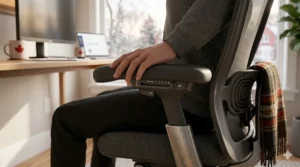
If you’re under about 5’4″ and have ever felt your feet dangling, your knees pressed against the front edge of the seat, or lumbar padding pushing into your shoulder blades instead of your lower back, a standard “one-size-fits-most” chair simply wasn’t built with your proportions in mind — and that’s a fit problem, not a willpower problem.
Quick Comparison Table
| Chair | Best For | Min. Seat Height | Price Range (CAD)* |
|---|---|---|---|
| Amazon Basics Classic | Tightest budget | ~17.5″ (44 cm) | $90–$140 |
| NEO CHAIR Ergonomic Mesh | Budget mesh/breathability | ~17″ (43 cm) | $150–$220 |
| Flash Furniture Mid-Back Mesh | Budget, simple setup | ~17″ (43 cm) | $160–$240 |
| Sihoo M59AS | Purpose-built petite fit | ~16.5″ (42 cm) | $260–$380 |
| Sidiz T50 | Adjustable seat depth | ~16.7″ (42.5 cm) | $420–$520 |
| HON Ignition 2.0 | Trusted everyday office use | ~17″ (43 cm) | $380–$480 |
| Steelcase Series 1 | Long-term, premium build | ~15.5″ (39.5 cm) | $550–$700 |
*Approximate ranges in CAD based on typical Amazon.ca and retail pricing at time of research. Always check Amazon.ca for the current listed price, as it changes frequently.
Looking at this table, the gap between the cheapest and most expensive options isn’t really about “better cushioning” — it’s about how low the seat goes and how much of the chair actually adjusts to a shorter frame. The budget picks get you sitting upright for a few hours a day; the Sidiz, HON, and Steelcase options are built for people who sit 7–8 hours daily and need the lumbar and seat depth to keep tracking with them over years of use, not just out of the box.
💬 Just one click — help others make better buying decisions too! 😊
✨ Don’t Miss These Exclusive Deals!
🔍 Take your home office setup to the next level — click through to check current pricing and availability on Amazon.ca before stock or pricing changes.
Top 7 Office Chairs for Short People — Expert Analysis
1. Amazon Basics Classic Puresoft Office Chair
Amazon Basics Classic Puresoft Office Chair is the chair to buy if you need something usable today without overthinking it. It’s a mid-back, PU-padded chair with basic height adjustment and a fixed lumbar curve — no seat-depth adjustment, no recline lock, no lumbar height tuning. For a short user, the main thing that matters is that the seat height range starts low enough for most people around 5’0″ and up to plant their feet flat, especially with a footrest underneath. What it won’t do is fix posture problems on its own; this is a starter chair, not a long-haul one.
Customer feedback on Amazon consistently describes it as decent for light, part-time desk use but not something people keep past a year or two of daily 8-hour sitting.
✅ Pros: very low cost, easy assembly, widely stocked on Amazon.ca
❌ Cons: no seat-depth adjustment, lumbar support is basic and non-adjustable
Price: roughly $90–$140 CAD. Best for: occasional home-office use, a starter chair for a student or spare room, or anyone testing whether a lower seat height actually solves their discomfort before spending more.
2. NEO CHAIR Ergonomic Mesh Office Chair
NEO CHAIR Ergonomic Mesh Office Chair swaps the padded seat for breathable 3D air mesh, which matters more than it sounds like for short users — because a lower seat height with a hot, sweaty mesh-free cushion is a worse combination over a Canadian summer in a non-air-conditioned condo. It has a BIFMA/SGS-tested gas lift, height adjustment, tilt lock, and basic lumbar support built into the mesh contour rather than a separate adjustable pad.
What most buyers overlook with mesh chairs at this price is that the mesh itself does the lumbar-shaping work — there’s no fine-tuning, so if your lower back sits noticeably higher or lower than average for your height, the support may not land exactly where you need it.
✅ Pros: breathable mesh, certified gas lift and casters, low price for mesh construction
❌ Cons: lumbar position isn’t adjustable, weight capacity capped around 250–270 lb
Price: roughly $150–$220 CAD. Best for: warmer rooms, home offices without strong air conditioning, and anyone who finds padded seats uncomfortable after a few hours.
3. Flash Furniture Mid-Back Mesh Task Chair
Flash Furniture Mid-Back Mesh Task Chair is a step up in build quality from the absolute entry-level chairs while staying in budget territory. It’s commonly sold on Amazon.ca and tends to ship quickly across most provinces. The mid-back mesh design with a curved lumbar zone helps it sit a bit more naturally against a shorter spine than flat-backed budget chairs, and the swivel base and casters are rated for typical home-office flooring.
In practice, this is the chair people buy when they want “ergonomic-ish” without committing to a $400+ purchase, and most feedback reflects that — solid for part-time work, with some users noting the padding softens faster than pricier chairs.
✅ Pros: reasonable mesh lumbar contour, fast availability on Amazon.ca, simple assembly
❌ Cons: padding wears faster than premium chairs, limited arm adjustability
Price: roughly $160–$240 CAD. Best for: home offices, secondary workstations, or anyone furnishing a room on a tight timeline.
4. Sihoo M59AS
Sihoo M59AS is one of the few chairs in this list explicitly sized for people between about 4’11” and 5’6″ rather than retrofitted from a standard frame, and that distinction shows up in the details: a dual-back design that separates the upper and lower backrest sections, plus an adaptive lumbar pillow that shifts with you instead of staying fixed in one spot. For someone whose torso is genuinely shorter than the average chair assumes, that moving lumbar zone is the single biggest practical difference over a fixed pad — it keeps contact with your lower back through recline rather than sliding up your spine.
The 3D flip-up armrests adjust front-to-back and side-to-side, which helps short users whose elbows often sit too far from a fixed armrest. Reviewers commonly mention noticeably better lower-back comfort during long sessions, alongside a straightforward (if slightly involved) assembly process.
✅ Pros: purpose-sized for shorter/petite frames, adaptive lumbar tracks with movement, flip-up 3D armrests
❌ Cons: assembly takes longer than basic chairs, mesh tension may feel firm to some users
Price: roughly $260–$380 CAD. Best for: short or petite users who sit most of the workday and have struggled with lumbar support sliding out of position on other chairs.
5. Sidiz T50
Sidiz T50 earns its spot here for one specific feature: a seat pan that adjusts in depth down to about 18.3″ (46.5 cm), which matters enormously if your seat-to-knee length is shorter than the chair’s default — without that adjustment, the front edge of most chairs presses behind the knees and cuts circulation over a long day. Pair that with a reasonably low minimum seat height and you get a chair that fits a genuinely wide range of shorter frames rather than just shorter-than-average ones.
The fabric upholstery and firmer cushion won’t suit everyone — some reviewers note it runs firmer than mesh alternatives — but for moderate-to-long sitting, the adjustable depth is doing real ergonomic work that most budget chairs simply can’t offer.
✅ Pros: genuinely adjustable seat depth, solid mid-range build quality, good for moderate-to-long sitting
❌ Cons: firmer cushion than mesh competitors, fabric (not mesh) so less breathable in warm rooms
Price: roughly $420–$520 CAD. Best for: short users whose main complaint is the seat edge hitting behind the knees, not just seat height.
6. HON Ignition 2.0
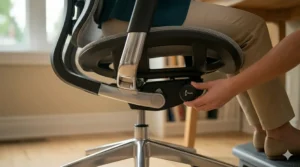
HON Ignition 2.0 is a workhorse chair from one of the longest-standing names in North American office furniture, and it shows up in plenty of Canadian corporate and government offices for a reason: consistent build quality and a flexible lumbar-and-recline system that adjusts to a wide range of body types rather than one default. For shorter users specifically, the adjustable lumbar height and synchro-tilt mechanism mean you can dial in support without needing the most expensive chair on the list.
What stands out in practice is durability — this is a chair rated for heavy daily use over years, not a chair you’ll be replacing in 18 months, which matters if you’re calculating cost-per-year rather than just the upfront price.
✅ Pros: adjustable lumbar height, durable build trusted in commercial settings, strong warranty support
❌ Cons: pricier than budget mesh options, seat height range still suits “short” more than “very petite” users without a footrest
Price: roughly $380–$480 CAD. Best for: anyone working full-time hours who wants office-grade durability without jumping to premium pricing.
7. Steelcase Series 1
Steelcase Series 1 is the chair to consider if you sit long hours every day and want the adjustability of a flagship chair without paying flagship prices — it shares core ergonomic DNA with Steelcase’s pricier Leap and Gesture lines but in a simpler, lighter-weight package. Its minimum seat height runs lower than most of the other chairs here, which is the single biggest factor for very short users trying to sit with feet flat and no footrest.
The recline and lumbar tuning take a bit of trial and error to set up correctly, but once dialled in, the seat-to-back relationship holds up well over an 8-hour day. Reviewers and ergonomics-focused buying guides consistently rank it among the better fits for petite users specifically because of that low seat-height ceiling.
✅ Pros: one of the lowest minimum seat heights on this list, strong recline and lumbar adjustability, 12-year warranty backing
❌ Cons: highest price point here, four-way arm adjustment may be a separate configuration rather than standard
Price: roughly $550–$700 CAD — note that Steelcase pricing and exact configuration availability can vary on Amazon.ca, so confirm the specific listing before buying. Best for: short or petite users in a long-term home office setup who’d rather pay once than replace a chair every couple of years.
Top 7 — Full Comparison Table
| Chair | Min. Seat Height | Lumbar Adjustability | Best For | Price (CAD)* |
|---|---|---|---|---|
| Amazon Basics Classic | ~17.5″ (44 cm) | Fixed | Light/occasional use | $90–$140 |
| NEO CHAIR Mesh | ~17″ (43 cm) | Fixed (mesh contour) | Warm rooms, breathability | $150–$220 |
| Flash Furniture Mid-Back | ~17″ (43 cm) | Fixed | Fast, budget setup | $160–$240 |
| Sihoo M59AS | ~16.5″ (42 cm) | Adaptive (moves with you) | Petite-specific fit | $260–$380 |
| Sidiz T50 | ~16.7″ (42.5 cm) | Height-adjustable | Short seat-to-knee length | $420–$520 |
| HON Ignition 2.0 | ~17″ (43 cm) | Height-adjustable | Daily full-time office use | $380–$480 |
| Steelcase Series 1 | ~15.5″ (39.5 cm) | Fully adjustable | Long-term, very low seat need | $550–$700 |
*Prices fluctuate on Amazon.ca — treat these as planning ranges, not quotes.
The clearest pattern in this table is that minimum seat height drops as price rises, and that’s not a coincidence — getting a chair’s gas cylinder and frame geometry to go genuinely low without sacrificing stability costs more to engineer than a one-size-fits-most frame. If your feet already touch the floor on most “standard” chairs and your main issue is lumbar position, the Sihoo M59AS or Sidiz T50 will likely solve it for less money than the Steelcase. If you’re closer to 4’10″–5’0″ and a footrest still doesn’t fully fix things, the lower seat height on the Steelcase Series 1 is doing work the others can’t.
How to Choose an Office Chair for Short People in Canada
- Measure your seat-to-knee length, not just your height. Two people who are both 5’2″ can need different seat depths depending on leg proportion — sit on a hard chair and measure from your back to just behind your knee.
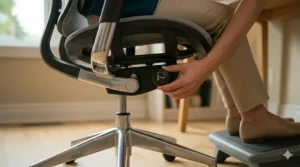
- Check the minimum seat height listed by the manufacturer, not the “average” range. Anything above about 17″ (43 cm) minimum will leave most people under 5’2″ with dangling feet even at the lowest setting.
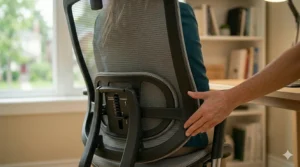
- Prioritize adjustable or adaptive lumbar support over fixed cushions. A fixed lumbar pad is built for an average torso length — if yours is shorter, it often sits at shoulder-blade height instead of lower-back height.
- Budget for a footrest if the seat height still doesn’t quite reach the floor. A $30–$50 CAD footrest paired with a mid-range chair frequently outperforms a much pricier chair without one.
- Factor in Canadian winter humidity for mesh vs. fabric. Forced-air heating dries indoor air significantly in winter; mesh breathes better in summer, but fabric can feel less static-prone in a dry, heated home office.
- Confirm the return policy before assembling. Amazon.ca’s standard return window typically covers 30 days on most chairs, but always confirm on the specific listing — fit issues are common enough that this matters more for chairs than almost any other furniture category.
- Don’t assume Prime shipping speed applies everywhere. Buyers in more remote or northern communities should check estimated delivery windows on the listing, since large furniture items can take noticeably longer to arrive outside major urban centres.
Real-World Scenarios: Matching the Chair to the Canadian Buyer
The downtown Toronto condo worker (5’1″, hybrid schedule, small space): Limited square footage and frequent moving between desk and couch make the lightweight NEO CHAIR Mesh or Flash Furniture Mid-Back a sensible pick — low commitment, easy to fit in a compact space, and good enough for 3–4 days a week of desk work.
The Calgary home-office full-timer (5’3″, 8-hour days, dry winter air): Daily long sitting plus a dry, forced-air-heated home points toward the Sihoo M59AS or HON Ignition 2.0 — both offer enough lumbar adjustability to matter over a full workday, and the breathable build handles indoor heating better than a fully upholstered chair.
The Ottawa professional working from a government or corporate-adjacent home setup (5’0″, years-long setup, budget for quality): Where durability and long-term ergonomic support outweigh upfront cost, the Steelcase Series 1’s low seat height and multi-year warranty make more financial sense amortized over 5+ years than replacing a cheaper chair twice in that time.
Common Problems and Solutions for Short Office Chair Buyers
- Problem: Feet don’t reach the floor even at the lowest seat setting. Solution: add an adjustable footrest, or move to a chair with a lower minimum seat height like the Sihoo M59AS or Steelcase Series 1 rather than relying on cushions to compensate.
- Problem: Front edge of the seat presses behind the knees. Solution: look specifically for seat-depth adjustment (the Sidiz T50 is built for this) rather than just a “petite” label, since not all petite-marketed chairs actually adjust depth.
- Problem: Lumbar support sits too high, pressing into the mid-back instead of the lower back. Solution: prioritize chairs with height-adjustable or adaptive lumbar (Sihoo M59AS, HON Ignition 2.0, Steelcase Series 1) over fixed lumbar curves.
- Problem: Chair arrives and clearly doesn’t fit, but it’s already assembled. Solution: check the Amazon.ca return policy on the specific listing before assembly — some sellers charge return shipping on large furniture, so confirm this upfront rather than after the fact.
- Problem: Service or replacement parts are hard to source in Canada for some lesser-known brands. Solution: favour brands with an established Canadian or North American distribution presence (HON, Steelcase, Sihoo) over no-name listings if you expect to need replacement casters, gas cylinders, or armrest pads down the line.
Common Mistakes When Buying an Office Chair for Short People
A frequent mistake is buying based on the word “petite” in the title alone without checking the actual minimum seat height in the spec sheet — some “petite” marketing simply means a narrower seat width, not a lower seat height, which doesn’t help if your main issue is reaching the floor.
Another common one: skipping the footrest entirely because “the chair should just fit.” Even genuinely petite-sized chairs sometimes leave a centimetre or two of gap for shorter users, and a $30–$50 CAD footrest closes that gap for far less than chasing an even lower-seated, pricier chair.
A third mistake specific to Canadian buyers: not checking whether a listing ships to your province or northern community within a reasonable window before committing to a return-heavy “try a few chairs” strategy — return shipping on furniture can erode the savings of buying multiple budget chairs to test fit.
Long-Term Cost and Maintenance in Canada
A $120 CAD budget chair that needs replacing every 18 months works out to roughly $80 CAD per year before factoring in the hassle of disposal and re-ordering. A $450 CAD mid-range chair with a 3–5 year practical lifespan lands closer to $90–$150 CAD per year — similar or better value once you account for comfort and reduced replacement frequency. Premium options like the Steelcase Series 1, backed by multi-year warranties, often work out cheapest per year of use for anyone planning to keep the same chair for 5+ years, even though the upfront price is highest.
Maintenance-wise, gas cylinders and casters are the most common failure points regardless of price tier. Established brands with North American distribution (HON, Steelcase, Sihoo) are generally easier to source replacement parts for in Canada than smaller, lesser-known imports.
Canadian Regulations and Standards Worth Knowing
Most quality office chairs sold in Canada and the U.S., regardless of price tier, are tested against ANSI/BIFMA standards (the North American furniture industry’s safety and durability testing body) — several chairs in this list explicitly cite BIFMA-tested gas lifts and bases. There’s no Canada-specific furniture safety certification equivalent to BIFMA, so BIFMA compliance is the main signal to look for on a spec sheet.
For ergonomic setup guidance specifically, the Canadian Centre for Occupational Health and Safety (CCOHS) — a federal agency — publishes detailed, free guidance on selecting and adjusting an ergonomic chair, including how to measure for proper seat height and lumbar position. Their companion guide on adjusting office chairs is a genuinely useful reference once your chair arrives, regardless of which model you choose.
As general consumer products, office chairs sold in Canada also fall under federal bilingual labelling requirements for packaging, so don’t be surprised to see English/French packaging even on U.S.-manufactured chairs sold through Amazon.ca.
FAQ
❓ What is the best seat height for a short person's office chair?
❓ Do petite office chairs ship to all provinces in Canada?
❓ Is a footrest better than a lower chair for short people?
❓ How much should I budget for a good office chair in Canada?
❓ Can I return an office chair on Amazon.ca if it doesn't fit?
Conclusion
For most short or petite buyers in Canada, the right chair comes down to two numbers you can check before buying: minimum seat height and seat depth adjustability. Budget mesh options like the NEO CHAIR or Flash Furniture solve part-time comfort cheaply; the Sihoo M59AS and Sidiz T50 are built specifically around shorter proportions; and the HON Ignition 2.0 or Steelcase Series 1 make more sense if you’re sitting full-time for years to come. Whichever you pick, pair it with a footrest if needed and take ten minutes with CCOHS’s chair-adjustment guide once it arrives — proper setup matters almost as much as the chair itself.
Recommended for You
- 7 Best Office Chairs for Tall People in Canada (2026 Guide)
- 7 Best Saddle Chairs for Dentists in Canada 2026
- Best Saddle Chairs in Canada 2026: 7 Top Picks for Posture & Pain Relief
Disclaimer: This article contains affiliate links. As an Amazon Associate, I earn from qualifying purchases. If you purchase products through these links, we may earn a small commission at no additional cost to you.
Found this helpful? Share it with your friends! 💬🤗
