
In This Article
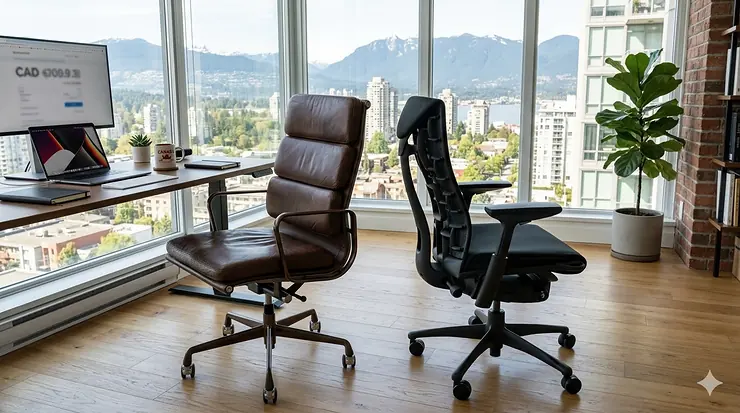
Picture this: you’re scrolling through Amazon.ca at 11 PM, coffee in hand, desperately seeking the perfect office chair that won’t leave you wincing after three hours of Zoom calls. The product listings blur together—genuine leather, bonded leather, faux leather, vegan leather. What does it all mean? And more importantly, which one won’t have you regretting your purchase six months down the road?
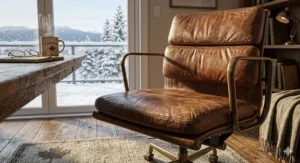
The genuine leather vs faux leather office chair conversation has become surprisingly complex in 2026. It’s no longer just about animals versus plastics or luxury versus budget. Modern manufacturing has blurred the lines so effectively that even experienced buyers find themselves second-guessing their choices. For Canadian shoppers navigating winter temperature swings, humidity changes, and the unique demands of year-round home office use, picking the right material matters more than you might think.
Here’s what most furniture salespeople won’t tell you: genuine leather typically lasts between five to ten years, while high-quality faux options might give you three to five years of solid use. But that’s just scratching the surface. The real story involves breathability during those sticky July afternoons, cold-weather cracking during February deep freezes, maintenance routines that actually fit into your life, and whether that “investment piece” truly pays off over time.
This guide cuts through the marketing fluff to give you the straight goods on genuine leather vs faux leather office chair options available to Canadians in 2026. We’ll examine real products with actual CAD pricing, break down durability expectations based on material science (not sales pitches), and help you figure out which type suits your specific work-from-home situation. Whether you’re outfitting a corporate office in Toronto or setting up a cozy workspace in rural Saskatchewan, you’ll walk away knowing exactly what to look for.
Quick Comparison Table: Genuine Leather vs Faux Leather Office Chair
| Feature | Genuine Leather | Faux Leather |
|---|---|---|
| Average Lifespan | 5-10 years | 2-5 years |
| Price Range (CAD) | $400-$1,200+ | $150-$500 |
| Breathability | Excellent (natural material) | Limited (plastic-based) |
| Temperature Sensitivity | Feels warm in winter, cool in summer | Can feel sticky in heat, cold in winter |
| Maintenance | Requires conditioning every 3-6 months | Wipe clean with damp cloth |
| Environmental Impact | Byproduct of meat industry; biodegradable | Plastic-based; takes 500+ years to decompose |
| Initial Smell | Natural leather aroma | Chemical/plastic odor (fades over time) |
| Aging Characteristics | Develops attractive patina | May crack, peel, or become sticky |
| Best For | Long-term investment, traditional aesthetics | Budget-conscious, easy maintenance, animal-free |
💬 Just one click – help others make better buying decisions too!😊
Top 7 Genuine Leather vs Faux Leather Office Chairs: Expert Analysis
1. La-Z-Boy Delano Big and Tall Executive Office Chair (Bonded Leather)
The La-Z-Boy Delano represents what happens when a legendary comfort brand decides to play in the office furniture space. This chair doesn’t mess around with its 350-pound capacity, making it genuinely accessible for bigger builds without the usual compromises.
Key Specifications:
- Material: Bonded leather with mahogany wood armrests
- Weight capacity: 350 lbs (159 kg)
- Price range: $350-$450 CAD on Amazon.ca
- Available colours: Chestnut brown, black
The bonded leather here sits somewhere between genuine and faux—it contains about 10-20% real leather scraps bonded with polyurethane. Canadian buyers report the chair holds up well through seasonal changes, though the leather can show wear faster than full-grain options. The ComfortCore memory foam system genuinely makes a difference during those marathon work sessions that stretch past dinner time.
Canadian Customer Feedback: Reviews from Ontario and British Columbia buyers consistently praise the sturdy construction and immediate comfort. A few Nova Scotia users mentioned assembly can be tricky solo, recommending a buddy for the 20-minute setup.
✅ Pros:
- Heavy-duty build quality for larger users
- Memory foam stays comfortable for 6+ hour sessions
- Wood armrests add premium feel
❌ Cons:
- Bonded leather may peel after 2-3 years with heavy use
- Assembly requires two people for best results
2. La-Z-Boy Nova Executive Office Chair (Vegan Faux Leather)
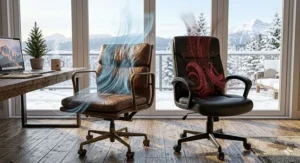
La-Z-Boy Nova brings their patented AIR Lumbar Technology to the faux leather category, creating something that actually adapts as you move. The vegan leather feels surprisingly premium—soft without that cheap plasticky texture that screams “budget chair.”
Key Specifications:
- Material: High-quality vegan PU leather
- Weight capacity: 350 lbs (159 kg)
- Price range: $400-$500 CAD
- American Chiropractic Association endorsed
This chair tackles the biggest complaint about faux leather: it flexes with your body instead of fighting it. The AIR technology means the lumbar support pivots as you twist or lean, maintaining contact with your lower back. For Canadian winters where you might layer up with sweaters, that adaptability prevents pressure points.
Canadian Customer Feedback: Manitoba users appreciate how the chair doesn’t freeze up in cold home offices, while Quebec buyers note the vegan leather wipes clean easily after coffee spills.
✅ Pros:
- Dynamic lumbar support moves with you
- Vegan leather stays supple in varying temperatures
- 350-pound capacity without feeling oversized
❌ Cons:
- Premium price point for faux leather
- Vegan leather may show scratches more readily than genuine
3. Serta Works Ergonomic Executive Chair (Chestnut Bonded Leather)
The Serta Works chair earned its reputation by actually delivering on the “ergonomic” promise. The Back in Motion Technology isn’t just marketing speak—it genuinely promotes core movement and flexibility while you’re seated.
Key Specifications:
- Material: Chestnut bonded leather
- Back in Motion active seat technology
- Price range: $280-$380 CAD on Amazon.ca
- Standard weight capacity: 250 lbs (113 kg)
Canadian buyers living in older homes with drafty windows report this chair maintains comfort even when room temperatures fluctuate. The bonded leather provides enough breathability to prevent that sticky-back syndrome during summer months, though it won’t match genuine leather’s natural temperature regulation.
Canadian Customer Feedback: Toronto users working 8-10 hour days consistently mention reduced back tension. Some Alberta buyers note the chestnut colour shows dust more readily in dry winter conditions.
✅ Pros:
- Active seat technology promotes spinal movement
- Mid-range pricing sweet spot
- Adjustable armrests accommodate different desk heights
❌ Cons:
- 250 lb limit excludes some users
- Bonded leather may crack with prolonged direct sunlight
4. Serta Big & Tall Commercial Office Chair (Black Bonded Leather)
For Canadians who need serious support without the thousand-dollar price tag, the Serta Big & Tall Commercial delivers. This isn’t the chair for occasional WFH days—it’s built for people actually living in their home offices.
Key Specifications:
- Material: Commercial-grade bonded leather
- Weight capacity: 350 lbs (159 kg)
- Price range: $320-$420 CAD
- Memory foam cushioning
The commercial-grade designation means reinforced components designed for daily, multi-hour use. Canadian buyers in professions requiring extended sitting (programmers, accountants, writers) report this chair maintains its shape and support far better than standard home-office models at similar price points.
Canadian Customer Feedback: Saskatchewan users appreciate the generous seat width for winter clothing layers. British Columbia reviewers mention the five-caster base glides smoothly on both hardwood and carpet.
✅ Pros:
- Commercial components outlast standard residential chairs
- Wide seat accommodates layered clothing
- Memory foam provides consistent support
❌ Cons:
- Bonded leather not as durable as genuine leather
- Assembly instructions could be clearer
5. La-Z-Boy Bellamy Executive Office Chair (Faux Bonded Leather)
The La-Z-Boy Bellamy nails the “classic executive” aesthetic without demanding executive-level pricing. Those darkly stained wood arms aren’t just decorative—they’re actually sculpted for comfortable armrest positioning.
Key Specifications:
- Material: Faux brown bonded leather
- Premium wood armrests and accents
- Price range: $300-$400 CAD
- Weight capacity: 275 lbs (125 kg)
This chair succeeds because it doesn’t try to be everything. It focuses on delivering traditional office chair comfort with materials that keep the price reasonable. The waterfall seat edge genuinely helps with circulation during long sitting sessions—a detail that matters more than most people realize until they experience it.
Canadian Customer Feedback: Ontario buyers working from converted dining rooms appreciate how the wood accents coordinate with existing furniture. Some Quebec users mention the brown leather patinas nicely over the first year.
✅ Pros:
- Wood armrests add genuine premium feel
- Waterfall edge improves leg circulation
- Classic styling ages well aesthetically
❌ Cons:
- Bonded leather may peel after 2-3 years
- 275 lb capacity lower than competitors
6. Serta Bryce Executive Office Chair (Bonded Leather with AIR Technology)
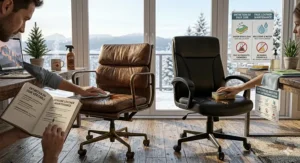
The Serta Bryce represents Serta’s attempt to combine their comfort technology with practical office functionality. The perforated back isn’t just design flair—it actually addresses one of bonded leather’s biggest weaknesses by adding airflow.
Key Specifications:
- Material: Perforated bonded leather
- AIR Lumbar Technology
- Price range: $280-$350 CAD on Amazon.ca
- Weight capacity: 275 lbs (125 kg)
The perforations make a real difference during Canadian summers when working from a room without AC. Instead of developing that characteristic “stuck to the chair” feeling after an hour, air actually circulates through the backrest. It’s a small design choice that significantly impacts daily comfort.
Canadian Customer Feedback: Manitoba users working in non-climate-controlled spaces praise the breathable back design. Some Atlantic Canada buyers note the gray colour option hides wear better than black.
✅ Pros:
- Perforated back provides superior breathability for bonded leather
- AIR technology delivers dynamic lumbar support
- Multiple colour options suit different office aesthetics
❌ Cons:
- Perforations may catch clothing or collect dust
- Bonded leather still less durable than genuine
7. La-Z-Boy Sutherland Quilted Leather Office Chair (Faux Leather)
The La-Z-Boy Sutherland brings contemporary design to the faux leather category with its diamond-quilted pattern. Beyond aesthetics, that quilting actually adds structural integrity to the faux leather, helping it resist the typical cracking patterns.
Key Specifications:
- Material: Diamond-quilted faux leather
- Chrome arms and base
- Price range: $250-$350 CAD
- Weight capacity: 250 lbs (113 kg)
This chair targets buyers who want modern styling without sacrificing comfort fundamentals. The chrome finish on the arms and base brings visual interest, while the quilted pattern creates texture that feels more premium than flat faux leather. Canadian buyers furnishing modern home offices or updating corporate spaces appreciate the contemporary aesthetic.
Canadian Customer Feedback: Toronto users in condos with modern decor consistently mention the chair looks more expensive than its price suggests. Some Prairie buyers note the chrome base shows fingerprints easily.
✅ Pros:
- Quilted design adds visual interest and structural support
- Chrome accents suit modern office aesthetics
- Pneumatic adjustment works smoothly
❌ Cons:
- Not recommended for hardwood floors (casters designed for carpet)
- Lower weight capacity than big-and-tall models
✨ Don’t Miss These Exclusive Deals!
🔍 Take your home office comfort to the next level with these carefully selected chairs available on Amazon.ca. Click on any highlighted item to check current pricing and availability. These chairs will help you create a workspace that actually supports your body through those long Canadian workdays!
Understanding the Leather Types: What You’re Actually Buying
When furniture retailers use terms like “genuine leather,” “bonded leather,” and “faux leather,” they’re describing fundamentally different materials with dramatically different performance characteristics. Let’s decode the terminology so you know exactly what you’re getting.
Genuine Leather: The Original Deal
Most leather production uses cattle hides, which constitute about 65% of all leather manufactured, with sheep, goats, and pigs making up most of the remainder. But “genuine leather” itself is actually a quality grade, not a guarantee of premium material.
Full-grain leather sits at the top tier, retaining the entire grain layer with all natural markings intact. This develops the famous patina over time—that rich, lived-in character that luxury leather goods acquire. Top-grain leather removes minor imperfections through light sanding, creating more uniform appearance while maintaining durability. “Genuine leather” as a label typically indicates lower-grade splits from beneath the top grain, processed and stamped to resemble higher grades.
For office chairs, genuine leather means excellent breathability, natural temperature regulation, and a lifespan measured in decades with proper care. The trade-offs? Higher upfront cost, regular conditioning requirements, and vulnerability to scratches (which often add character rather than detracting from appearance).
Faux Leather: The Synthetic Alternative
Modern faux leather comes primarily in two types: polyurethane (PU) and polyvinyl chloride (PVC). PU leather, often marketed as “vegan leather,” bonds polyurethane to a fabric backing—usually cotton or polyester. Since the 1960s, fabrics coated with polyurethane and polyvinyl chloride have become the preferred types of artificial leather, offering both appearance and durability improvements over earlier synthetics.
PVC leather uses vinyl coating for increased flexibility and water resistance, though it sacrifices breathability compared to PU options. Both materials provide uniform appearance, wide colour options, and easy maintenance. The downside? Faux leather will begin to break down or crack over time, typically showing wear after three to five years of regular use. Unlike genuine leather, synthetic materials don’t develop attractive aging characteristics—they simply deteriorate.
Bonded Leather: The Middle Ground Nobody Wanted
Bonded leather represents the industry’s attempt to use leather scraps by grinding them into particles, mixing with polyurethane binder, and rolling the mixture onto paper backing. Bonded leather typically contains only 10-20% genuine leather, with the remainder being adhesives and synthetic materials.
This creates a product that initially resembles leather but lacks the durability of either genuine leather or quality faux alternatives. Most bonded leather office chairs show significant deterioration after two to three years—peeling, flaking, or becoming sticky as the polyurethane coating degrades. For Canadian buyers, bonded leather represents false economy: cheaper than genuine but not durable enough to justify savings over quality faux leather.
Durability Showdown: Which Material Actually Lasts?
The durability question ultimately determines whether your chair purchase was investment or expensive mistake. Let’s examine how each material performs under real-world conditions Canadian office workers actually experience.
Genuine Leather’s Longevity Advantage
Real leather’s cellular structure gives it inherent flexibility and tear resistance. Given proper care, real leather far outlasts its counterparts in long-term endurance, and wear and tear that would damage other materials actually develops character and patina in genuine leather. That patina—the rich darkening and softening that occurs over years—makes vintage leather furniture more valuable, not less.
Canadian climates pose specific challenges for leather. Dry winter indoor air can cause cracking without regular conditioning. Summer humidity can promote mould if chairs don’t receive adequate air circulation. Yet properly maintained genuine leather office chairs routinely deliver 10-15 years of daily use, often outlasting the chairs’ mechanical components.
The conditioning requirement isn’t trivial: quality leather needs treatment every three to six months with appropriate products. Miss these treatments during harsh Prairie winters or humid Maritime summers, and you’ll see accelerated aging. Factor in the time and product cost when calculating genuine leather’s true expense.
Faux Leather’s Predictable Decline
Synthetic leather materials follow consistent degradation patterns. The polyurethane coating breaks down through hydrolysis—reaction between the coating and environmental moisture. Even the best quality faux leather is less durable than genuine leather, and rather than developing an attractive patina as it ages, it can scuff, tear, stiffen, break, or even become discoloured or sticky over time.
This process accelerates with temperature swings. Canadian homes cycling between heated winter interiors and spring/fall temperature fluctuations stress the plastic coating. Expect visible cracking or peeling to begin around year three for quality faux leather, earlier for budget options.
The upside? Faux leather’s degradation is predictable. You can plan replacement as part of your office furniture budget. And during its functional life, it requires virtually zero maintenance beyond occasional wiping with damp cloth. For buyers who prefer replacing furniture every few years anyway, faux leather’s shorter lifespan isn’t necessarily disadvantage.
Real-World Performance Comparison
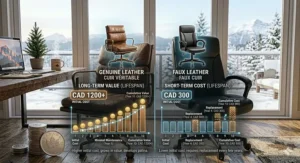
Testing by consumer groups reveals telling patterns. Chairs receiving eight hours of daily use show these typical lifespans:
Full-grain genuine leather: 12-20 years before requiring reupholstery
Top-grain genuine leather: 8-15 years of solid performance
Quality PU faux leather: 3-5 years before noticeable degradation
Budget PVC faux leather: 2-3 years before cracking/peeling begins
Bonded leather: 18-30 months before coating failure
For Canadians working from home five days weekly, this translates to clear cost-per-year calculations. A $600 CAD genuine leather chair lasting twelve years costs $50 annually. A $300 CAD faux leather chair lasting three years runs $100 yearly. The math shifts when you factor in conditioning products for genuine leather, but the genuine option still usually wins long-term.
Comfort and Breathability: The Daily Experience
Numbers and durability projections matter, but how does each material feel during an actual eight-hour workday? The comfort differences between genuine and faux leather extend beyond initial impressions.
Temperature Regulation: Where Genuine Leather Shines
Real leather offers unique natural texture and breathability, while faux leather has more uniform appearance but is generally less durable and not as breathable. That breathability creates tangible comfort differences for Canadian workers experiencing our temperature extremes.
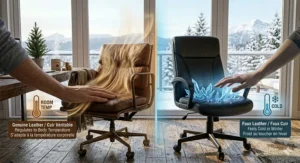
Genuine leather’s porous structure allows air circulation and moisture wicking. During summer heat waves when your home office hits 26°C (79°F), genuine leather prevents the sticky-back syndrome that plagues synthetic materials. The leather absorbs small amounts of perspiration and releases it gradually, maintaining comfortable contact with your body.
Winter brings opposite benefits. Leather initially feels slightly cool but rapidly warms to body temperature and maintains that warmth. Faux leather in unheated rooms feels cold and clammy, taking longer to warm and never quite achieving the natural warmth of genuine materials.
The Faux Leather Compromise
Modern high-quality PU leather has improved breathability compared to older vinyl options, but physics limits what synthetic materials can achieve. The plastic coating fundamentally prevents air circulation. Manufacturers address this through perforations, mesh inserts, or strategic material placement, but these remain workarounds rather than solutions.
For Canadian buyers in climate-controlled offices, breathability matters less. If your workspace maintains steady 20-22°C (68-72°F) year-round, faux leather’s comfort deficit shrinks considerably. But home office workers dealing with temperature swings—or anyone working summer days without AC—will notice the difference within hours.
Break-In Period and Long-Term Feel
Genuine leather typically requires a break-in period of several weeks as it conforms to your body shape. Initially, it may feel stiff compared to faux alternatives. But this break-in process creates personalized support that improves over time. The leather molds to your specific sitting patterns, providing customized comfort.
Faux leather feels immediately comfortable but doesn’t adapt. It maintains the same feel from day one through eventual deterioration. Some users prefer this consistency; others miss the personalized fit that genuine leather develops. Neither approach is objectively better—it depends whether you value immediate comfort or long-term adaptation.
Environmental Considerations: The Surprising Truth
The environmental debate around genuine versus faux leather defies simple categorization. Both materials carry ecological footprints that deserve honest examination.
Genuine Leather’s Complex Environmental Profile
Leather production begins as byproduct of the meat and dairy industries. Real leather represents a natural material, a renewable resource, and a byproduct of the food industry. Without leather manufacturing, these hides would require disposal, typically through landfilling or incineration.
The tanning process, however, raises legitimate environmental concerns. Traditional chrome tanning uses chromium salts and other chemicals requiring careful waste management. Water usage during tanning is substantial. Yet real leather reduces landfill waste because items made with it decompose over time, whereas artificial leather remains in landfills for hundreds of years.
For environmentally conscious Canadian buyers, sourcing matters. Leather from ranches practicing sustainable grazing and using vegetable tanning methods carries lower environmental impact than conventionally tanned alternatives. But researching sourcing for office chair upholstery proves challenging—manufacturers rarely provide this level of detail.
Faux Leather’s Plastic Problem
Synthetic leather avoids animal products entirely, appealing to vegan consumers. But the environmental trade-offs deserve consideration. Plastic-based leathers can take up to 500 years to decompose and as they break down, they release nefarious microplastics and toxic chemicals.
The manufacturing process for PU and PVC involves petroleum products and chemical treatments with their own environmental costs. And the shorter lifespan means more frequent replacement—each replacement requiring new manufacturing and creating disposal challenges.
Some Canadian municipalities accept office furniture at recycling facilities, but the mixed materials in bonded and faux leather chairs (metal, plastic, foam, fabric) complicate recycling. Most end up in landfills where synthetic materials persist indefinitely.
The Honest Assessment
Neither option delivers clear environmental superiority. Genuine leather wins on longevity and biodegradability but raises animal welfare and chemical processing concerns. Faux leather avoids animal products but creates persistent plastic waste and requires more frequent replacement.
Canadian buyers prioritizing environmental impact might consider: buying quality genuine leather chairs that last decades, purchasing used genuine leather chairs to avoid supporting new production, choosing faux leather from companies using recycled materials or bio-based alternatives, or exploring emerging plant-based leather alternatives from sources like mushroom mycelium or pineapple leaves (though these remain rare in office furniture).
Maintenance Reality: What You Actually Need to Do
Marketing materials promise “easy care” for both leather types, but daily reality tells a different story. Understanding actual maintenance requirements prevents buyer’s remorse down the road.
Genuine Leather Maintenance: The Regular Commitment
Quality leather demands attention. Every three to six months, leather chairs require conditioning with appropriate products to prevent drying and cracking. This process takes roughly 40 minutes per session: vacuum crevices, apply conditioner with soft cloth, allow absorption, buff excess.
Canadian climate considerations matter here. Winter heating systems create extremely dry indoor air—Edmonton winter humidity regularly drops below 20%. This accelerates leather drying, potentially requiring monthly conditioning rather than quarterly. Maritime provinces with higher humidity may extend conditioning intervals.
Beyond conditioning, genuine leather needs protection from direct sunlight (causes fading and cracking), immediate spill cleanup (liquids can stain if allowed to soak), and occasional deep cleaning with leather-specific cleaners. With proper care, leather goods such as bags and chairs can last for decades.
The product costs add up: quality leather conditioner runs $15-25 CAD per bottle, lasting roughly six months with regular use. Specialized cleaners add another $20-30 CAD annually. Over a genuine leather chair’s fifteen-year lifespan, expect spending $400-600 CAD on maintenance products beyond the initial purchase.
Faux Leather Maintenance: Simple Until It Isn’t
Faux leather maintenance is genuinely simpler during the material’s functional life. Wipe with damp cloth. That’s essentially it. Stubborn dirt responds to mild soap solution. No conditioning, no specialized products, no seasonal considerations.
This simplicity appeals to busy Canadians who’d rather spend weekends exploring the Rockies than treating furniture. The trade-off comes when degradation begins. Unlike genuine leather where conditioning can restore suppleness and extend life, faux leather deterioration is irreversible. Once cracking or peeling starts, no product repairs the damage. Replacement becomes your only option.
Bonded leather presents unique challenges. The polyurethane coating initially seems easy-care like faux leather. But when the coating inevitably begins flaking—usually around year two—the paper backing underneath becomes exposed. At this stage, the chair actively sheds small particles that settle on floors and clothing. This mess phase often prompts replacement before the mechanical chair components actually fail.
Canadian-Specific Considerations
Our climate extremes demand attention regardless of leather type. Homes using forced-air heating in winter benefit from humidifiers, protecting both genuine and faux leather from excessive drying. Basement offices in humid climates should ensure adequate ventilation—genuine leather can develop mildew in damp conditions, while moisture accelerates faux leather’s hydrolysis degradation.
For Canadians storing seasonal furniture, temperature-controlled storage matters. Unheated garages experiencing -30°C (-22°F) winter temperatures will damage both leather types. If storing office chairs during moves or renovations, choose climate-controlled units.
Price Analysis: Understanding the Real Investment
Purchase price tells only part of the financial story. Let’s examine total cost of ownership across each material’s expected lifespan for Canadian buyers in 2026.
Initial Investment Comparison
Genuine Leather Office Chairs (Amazon.ca, 2026):
- Budget range: $400-600 CAD (typically lower-grade genuine or minimal features)
- Mid-range: $600-900 CAD (good quality genuine leather, solid construction)
- Premium: $900-1,500+ CAD (full-grain leather, advanced ergonomics)
Faux Leather Office Chairs (Amazon.ca, 2026):
- Budget range: $150-250 CAD (basic construction, thin PU/PVC coating)
- Mid-range: $250-400 CAD (quality faux leather, decent ergonomics)
- Premium: $400-600 CAD (high-grade PU, advanced features)
The price overlap in mid-range creates decision points. A $400 CAD premium faux leather chair competes directly against entry-level genuine leather options. Which delivers better value depends on your specific situation and priorities.
Total Cost of Ownership
Scenario 1: Genuine Leather Path
- Initial purchase: $700 CAD (mid-range genuine leather)
- Conditioning products: $400 CAD over 15 years
- Replacement parts (casters, gas cylinder): $150 CAD
- Total 15-year cost: $1,250 CAD
- Annual cost: $83 CAD
Scenario 2: Faux Leather Path
- Initial purchase: $300 CAD (quality faux leather)
- Maintenance products: Minimal ($50 CAD over lifespan)
- Chair lifespan: 4 years
- Replacement purchases: $300 CAD × 3 = $900 CAD
- Total 15-year cost: $1,250 CAD
- Annual cost: $83 CAD
This calculation reveals surprising parity. The genuine leather chair costs more upfront but lasts longer. The faux leather option requires multiple replacements that ultimately equal the genuine option’s total expense. However, this assumes the genuine leather chair’s mechanical components survive fifteen years—not always guaranteed even with quality models.
The Hidden Value Variables
Several factors shift the value calculation:
Resale Value: Quality genuine leather chairs retain resale value. A well-maintained fifteen-year-old genuine leather chair might sell for $200-300 CAD. Faux leather chairs have negligible resale value after year two.
Workplace Evolution: If you anticipate changing your home office setup significantly within five years, faux leather’s shorter commitment might suit better than genuine leather’s long-term investment.
Warranty Coverage: Some manufacturers offer better warranties on genuine leather models. La-Z-Boy, for instance, provides extended coverage on their leather office chairs compared to faux alternatives. Factor warranty terms into value calculations.
Canadian Dollar Fluctuations: Since most office chairs ship from US or Asian manufacturers, CAD/USD exchange rates affect replacement costs. Buying quality genuine leather once provides some insulation against future currency shifts compared to multiple faux leather replacements.
Smell, Texture, and Aesthetic Differences
Beyond practical considerations lie subjective qualities that profoundly affect daily satisfaction with your chair purchase. These elements resist objective measurement but matter immensely to user experience.
The Scent Factor
Genuine leather has a characteristic natural smell that cannot be reliably faked; synthetic leather produces a plasticky, chemical odor. For leather enthusiasts, that distinctive aroma represents part of the product’s appeal. It evokes quality, tradition, and natural materials.
Faux leather’s chemical scent typically dissipates within weeks of unpacking, especially with adequate room ventilation. But sensitive users may find the off-gassing period unpleasant. Canadian buyers working from small home office spaces without windows might want to factor this into decision-making, particularly during winter when opening windows proves impractical.
Some manufacturers now use low-VOC (volatile organic compound) processes for faux leather production, reducing the chemical smell. Product descriptions rarely specify this, but customer reviews often mention whether chairs arrived with strong odours.
Tactile Experience
Touch reveals immediate differences. Genuine leather feels slightly uneven—subtle variations in grain pattern and texture reflect the material’s natural origin. It warms quickly to body temperature and develops softness through use. Running your hand across quality leather produces slight resistance, almost grip.
Faux leather feels uniformly smooth, sometimes almost slippery. When you run your fingers across faux leather, it feels cold and unnaturally even, and when pressed, the synthetic material simply depresses without stretching or wrinkling like natural skin. This consistency appeals to some users who prefer predictable, controlled aesthetics over organic variation.
Modern high-end faux leathers have improved dramatically. Premium PU leather with embossed grain patterns can fool casual observers. But sustained contact reveals the difference—fifteen minutes of sitting makes authentic versus synthetic unmistakable to most users.
Visual Aging: Patina Versus Deterioration
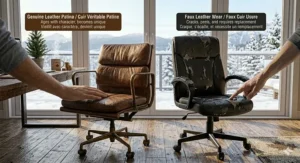
Perhaps the starkest difference emerges over time. Genuine leather darkens gradually, developing rich depth particularly in high-contact areas like armrests and seat edges. This patina signals quality and longevity. Vintage leather furniture often commands premium prices specifically because of attractive aging characteristics.
Faux leather doesn’t develop patina—it simply breaks down. Initial uniform appearance gives way to visible cracking, often along stress points where the chair bends. Colour may fade unevenly, particularly with sun exposure. The synthetic material doesn’t acquire character through age; it just looks worn out.
For Canadian buyers investing in home office aesthetics, this distinction matters. A five-year-old genuine leather chair in a video conference background communicates professionalism and permanence. A five-year-old faux leather chair showing characteristic cracking signals budget constraints and temporary setups—regardless of the user’s actual financial situation or professional standing.
FAQ
❓ How long does faux leather office chair durability compare to genuine leather in Canadian climate?
❓ What's the price difference between genuine leather and faux leather office chairs in Canada?
❓ Which leather type lasts longer for daily work-from-home use?
❓ Is genuine leather office chair a better investment for Canadian home offices?
❓ What are the best synthetic leather alternatives available on Amazon.ca in 2026?
Conclusion: Making Your Choice
The genuine leather vs faux leather office chair decision ultimately hinges on alignment between material characteristics and your specific situation. There’s no universal “best” option—only the right choice for your priorities, budget, and usage patterns.
Choose genuine leather if you value longevity above all else, work from home full-time and need furniture lasting a decade-plus, appreciate natural materials and developing patina over time, have budget flexibility for higher initial investment, or commit to regular maintenance routines including seasonal conditioning.
Opt for faux leather when you prioritize minimal maintenance requirements, anticipate relocating or upgrading within five years, prefer animal-free materials for ethical reasons, need to minimize upfront costs while accepting shorter lifespan, or work in climate-controlled environments where breathability matters less.
For most Canadian home office workers in 2026, quality genuine leather represents the better long-term value despite higher initial cost. The superior durability, comfort advantages during temperature extremes, and attractive aging characteristics justify the premium. However, buyers who genuinely prefer replacing furniture every few years or who struggle with regular maintenance tasks will find greater satisfaction with premium faux leather options.
Remember that material quality matters more than material type for practical performance. A well-constructed faux leather chair from La-Z-Boy or Serta outperforms a cheaply-made “genuine” leather chair from unknown manufacturers. Focus first on ergonomic features, build quality, and warranty terms—then use leather type as the tiebreaker between otherwise similar options.
Whatever you choose, buy from retailers offering solid return policies. Amazon.ca’s generous return windows let you test the chair in your actual workspace before commitment becomes final. That thirty-day trial period proves more valuable than any specification sheet or online review for determining whether a chair truly suits your needs.
Recommended for You
- 7 Best Leather Office Chairs Canada 2026
- 7 Best Chairs for Work From Home Canada 2026
- 7 Best Full Mesh Office Chair vs Mesh Back Canada 2026 Guide
Disclaimer: This article contains affiliate links to Amazon.ca. If you purchase products through these links, we may earn a small commission at no additional cost to you.
✨ Found this helpful? Share it with your friends! 💬🤗
