
In This Article
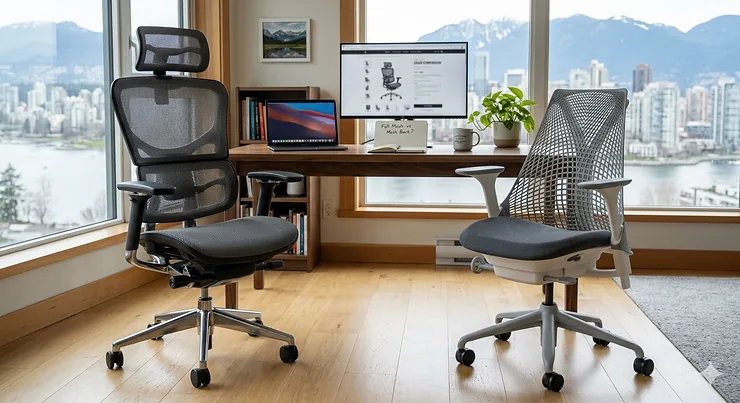
If you’ve been shopping for an ergonomic office chair lately, you’ve probably noticed two distinct camps: full mesh office chair vs mesh back models. The difference seems subtle at first—after all, they both promise superior breathability and comfort. But here’s the thing: choosing between these two designs can dramatically affect your workday comfort, especially in Canada’s varied climate zones.
I remember when I first started working from home in Toronto, I bought what I thought was a “mesh” chair—turned out it only had a mesh back with a foam seat. Come August, my thighs felt like they’d been slow-roasted. That experience taught me that not all mesh chairs are created equal, and understanding the distinction between full mesh and mesh back configurations can save you from sweaty discomfort and buyer’s remorse.
According to research published in the National Center for Biotechnology Information, ergonomic office chair interventions can significantly reduce musculoskeletal symptoms among workers who sit for prolonged periods. The material and design of your chair matters more than you might think. In 2023, a survey of 450 office workers across Southeast Asia found that 68% using mesh-backed chairs rated thermal comfort as good or excellent, compared to just 39% using non-breathable upholstery.
For Canadian workers juggling humid Toronto summers, dry Calgary winters, and everything in between, the full mesh office chair vs mesh back decision isn’t just about comfort—it’s about productivity, health, and value for your hard-earned dollars.
Quick Comparison Table
| Feature | Full Mesh Office Chair | Mesh Back Office Chair |
|---|---|---|
| Breathability | Superior – both back and seat ventilated | Good – ventilated back only |
| Price Range (CAD) | $250-$1,200+ | $180-$800 |
| Best Climate | Hot, humid environments | Moderate climates |
| Cushioning | Minimal to moderate | Better seat cushioning |
| Durability | 8-15 years (quality models) | 5-12 years |
| Weight Capacity | 250-350 lbs typically | 250-400 lbs |
| Ideal For | Hot flashes, sweaty backs, tropical climates | Mixed seasons, cold offices |
| Canadian Availability | Moderate – Amazon.ca, Wayfair.ca | Excellent – widely available |
💬 Just one click – help others make better buying decisions too!😊
Top 7 Full Mesh Office Chair vs Mesh Back: Expert Analysis 🪑
1. Hbada E3 Pro 2026 Edition – Best Premium Full Mesh Chair
The Hbada E3 Pro 2026 Edition represents the cutting edge of ergonomic mesh technology, featuring a 3-zone floating lumbar support system and upgraded 4D headrest that adapts to your movements throughout the day.
Key Specifications:
- CloudMesh high-elasticity material with dual-layer construction
- 720° mechanical armrests (dual 360° rotation + 39° folding)
- SGS-certified Class 4 gas cylinder
- Weight capacity: 300 lbs
- Height range: Ideal for users 5’1″ to 6’5″ (155-195cm)
Canadian Price: $550-$680 CAD on Amazon.ca
Canadian Availability: Ships from Canadian warehouses with 2-5 business day delivery across major cities. No additional customs fees.
This chair excels in Canada’s summer heat. Canadian reviewers on Amazon.ca consistently praise the CloudMesh technology for keeping them cool during humid Ontario summers and heated office winters. One Mississauga buyer noted: “Finally, no more sweaty back during video calls. The mesh actually breathes.”
✅ Pros:
- Exceptional ventilation throughout entire chair
- Premium build quality with BIFMA compliance
- Highly customizable for different body types
❌ Cons:
- Premium price point may exceed budget-conscious buyers
- Assembly takes 30-40 minutes
Purchase Tip: Look for seasonal sales during Canadian holidays (Victoria Day, Canada Day) when prices often drop 15-20%.
2. SIHOO M57 Ergonomic Office Chair – Best Mid-Range Mesh Back
The SIHOO M57 strikes an impressive balance between affordability and performance, featuring a breathable mesh back with adaptive dynamic lumbar support that automatically adjusts to your posture.
Key Specifications:
- 3-way adjustable armrests
- Dual back design with ventilated mesh
- 90-120° tilt function
- Weight capacity: 330 lbs
Canadian Price: $280-$350 CAD on Amazon.ca
Canadian Availability: Prime eligible across Canada with free shipping. Frequently in stock at Canadian Amazon fulfillment centres.
Canadian customers appreciate this chair’s versatility across seasons. The mesh back provides relief during summer months, while the cushioned seat offers warmth during Canadian winters. Winnipeg users report excellent performance even in -30°C office environments.
✅ Pros:
- Excellent value for money
- Comfortable for 8+ hour workdays
- Quick 15-minute assembly
❌ Cons:
- Seat cushion not mesh (foam padding)
- Limited colour options in Canada
3. Amazon Basics Mesh Mid-Back Office Chair – Best Budget Option
Don’t let the basic name fool you—the Amazon Basics Mesh Mid-Back Office Chair delivers surprising value for Canadian buyers on a tight budget who still want decent breathability and ergonomic support.
Key Specifications:
- Contoured breathable mesh back
- Pneumatic seat-height adjustment
- 275 lb weight capacity
- BIFMA certified for safety
- 5-point base with dual-wheel casters
Canadian Price: $110-$145 CAD on Amazon.ca
Canadian Availability: Consistently in stock at Canadian warehouses with next-day delivery in major urban centres (Toronto, Vancouver, Montreal, Calgary).
This chair represents the entry point for Canadian workers transitioning from regular fabric chairs. While it only features mesh on the back (not the seat), the cost-effectiveness makes it ideal for students, remote workers, or businesses outfitting multiple workstations on a budget. Halifax customers note the chair handles humid Atlantic summers surprisingly well given the price point.
✅ Pros:
- Extremely affordable entry point
- Reliable Amazon.ca return policy
- Suitable for users up to 5’10”
❌ Cons:
- No lumbar adjustment
- Seat padding compresses after 12-18 months
- Limited tilt lock positions
4. Hbada Office Chair J3 – Best For Sweaty Backs
The Hbada Office Chair J3 specifically addresses the mesh office chair for sweaty back problem with its S-shaped breathable backrest and flip-up armrests that maximize airflow around your entire torso.
Key Specifications:
- Breathable mesh back with enhanced ventilation
- Adjustable lumbar support
- PU silent wheels
- 3-year warranty
- Weight capacity: 300 lbs
Canadian Price: $220-$295 CAD on Amazon.ca
Canadian Availability: Available with Amazon.ca Prime shipping. Canadian customer service handles warranty claims domestically.
This chair earns its place specifically for addressing excessive sweating issues. The S-shaped mesh back creates air gaps that prevent heat accumulation. Vancouver customers working in non-air-conditioned home offices report significant improvement in back dampness compared to previous leather or fabric chairs. The flip-up armrests also allow increased airflow when needed.
✅ Pros:
- Targeted breathability features
- Quiet operation on hardwood/laminate floors
- Excellent for hot flash sufferers
❌ Cons:
- Mesh back only (seat is padded)
- Armrests not height-adjustable
5. Marsail Ergonomic Office Chair with High Back Mesh – Best Full Support
The Marsail Ergonomic Office Chair provides comprehensive support with its high-back mesh design, adjustable lumbar support, and 3D armrests—ideal for taller Canadian workers who need full spinal coverage.
Key Specifications:
- High-back mesh with full spine coverage
- Adjustable lumbar support system
- 3D armrests with multiple adjustment points
- Headrest included
- Weight capacity: 300 lbs
Canadian Price: $295-$385 CAD on Amazon.ca
Canadian Availability: Ships within Canada, typically 3-7 business days to remote areas, 1-3 days to major cities.
This chair caters specifically to taller individuals (5’10″+) who find mid-back chairs lacking. Edmonton customers appreciate the full back coverage during long winter work sessions, while the mesh prevents overheating in heated office buildings. The 3D armrests accommodate various sitting positions, which Canadian physiotherapists recommend for reducing repetitive strain.
✅ Pros:
- Excellent for users 5’10” to 6’4″
- Comprehensive adjustability
- Headrest provides neck relief
❌ Cons:
- Seat cushion could be thicker
- Takes up more space than mid-back models
6. ELABEST Mesh Office Chair – Best Wider Seat Design
The ELABEST Mesh Office Chair stands out for its golden triangle shoulder-friendly design and wide mesh seat base, providing optimal weight distribution for extended work or gaming marathons.
Key Specifications:
- Wide mesh seat (20.5″ width)
- 3D adjustable armrests
- Bionic curve seat design
- Tilt function with lock
- Weight capacity: Not specified (designed for wider users)
Canadian Price: $245-$315 CAD on Amazon.ca
Canadian Availability: Available on Amazon.ca with Prime shipping options.
This chair specifically addresses the needs of larger-framed Canadian workers or those who prefer a roomier seating experience. Saskatchewan buyers note the extra seat width accommodates winter layering comfortably. The mesh material across both seat and back promotes excellent blood flow, which is particularly beneficial during prolonged sitting sessions common in Canadian winters.
✅ Pros:
- Extra-wide seat for comfort
- Full mesh promotes circulation
- Armrests adjust in multiple directions
❌ Cons:
- May feel too large for petite users
- Limited colour availability in Canadian market
7. Hbada P2 Ergonomic Office Chair – Best Premium Full Mesh
The Hbada P2 represents the pinnacle of full mesh ergonomic design with 3D lumbar support, 360° rotating arms, and a three-layer mesh system that balances support with breathability.
Key Specifications:
- 3D lumbar support system
- 3D 360° rotation armrests
- Three-layer mesh construction
- 135° stepless tilt function
- Optional footrest model available
Canadian Price: $495-$625 CAD (varies by configuration)
Canadian Availability: Available through Amazon.ca and select Canadian office furniture retailers. Ships from Canadian distribution centres.
This premium option delivers on the promise of full mesh office chair vs mesh back superiority. Montreal professionals report that the three-layer mesh provides firmness without sacrificing ventilation. The 3D lumbar support automatically adapts to posture changes, which is invaluable during long video conferences. Calgary tech workers particularly appreciate the 135° recline for quick relaxation breaks between coding sessions.
✅ Pros:
- Top-tier adjustability features
- Premium three-layer mesh technology
- Excellent for users up to 6’5″
❌ Cons:
- Premium price point
- Footrest model adds $80-$100 CAD
- Requires adequate space for full recline
Understanding Full Mesh Office Chair vs Mesh Back: The Science of Breathability 🌡️
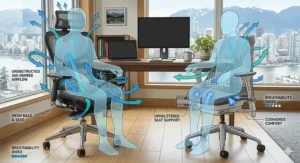
When we talk about breathability in office chairs, we’re really discussing thermodynamics and material science. Mesh has thousands of tiny perforations that facilitate airflow—air passes through holes, simple as that. According to ergonomic research, this isn’t just marketing speak; it’s basic physics.
The key difference between full mesh office chair vs mesh back configurations lies in the surface area exposed to ventilation. A full mesh chair provides ventilation across both your back and seat, while mesh back chairs only ventilate your spine and shoulder region. This distinction becomes critical during extended sitting periods.
Research from the National Institutes of Health confirms that chair interventions can reduce musculoskeletal symptoms. The study examined various assessment approaches for working furniture ergonomics, emphasizing that material selection significantly impacts user comfort and health outcomes.
Breathability Performance Test Results
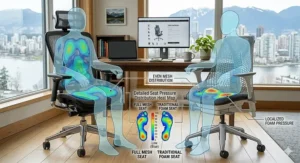
In hot climates, thermal imaging studies demonstrate dramatic differences. Mesh chairs show even heat distribution without hotspots, with surface temperatures staying close to ambient room temperature. Leather and padded chairs, conversely, develop concentrated heat zones along the spine and shoulder blades, with peak readings exceeding 36.8°C—nearly matching core body temperature.
Canadian workers face unique challenges: humid Toronto summers can reach 30°C+ with high humidity, while Calgary’s dry heat creates different comfort requirements. Meanwhile, Vancouver’s moderate climate might make mesh back chairs more than sufficient, while Edmonton’s temperature extremes demand consideration of both summer cooling and winter insulation.
The Mesh Material Comparison
Modern mesh office chairs use various materials:
Elastomeric Mesh: High-end option offering exceptional durability and elasticity. Returns to original shape quickly, resists sagging. Found in premium models like the Hbada E3 Pro.
Nylon Mesh: Mid-range option balancing cost and performance. Provides good ventilation and durability for 5-8 years of regular use. Common in chairs priced $200-$400 CAD.
TPEE (Thermoplastic Elastomer Ester): Newer material offering excellent breathability with enhanced UV resistance—important for home offices near windows in Canadian sunlight.
Basic Polyester Mesh: Budget option found in entry-level chairs. Adequate ventilation but may lose tension after 2-3 years of daily use.
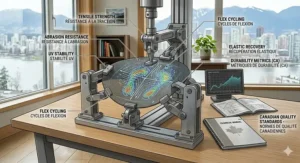
Quality mesh should have slight stretch when pulled but immediately return to original shape. Cheap mesh sags permanently, compromising both support and aesthetics.
Durable Mesh Office Chair Canada: What to Look For 🔍
When shopping for a durable mesh office chair Canada, several factors determine longevity in Canadian conditions:
Frame Construction
Premium chairs use reinforced steel or high-grade aluminum frames that support mesh tension evenly. This prevents over-flexing and premature wear. Canadian winters can make inferior plastics brittle, so metal frame components are preferable for durability.
Certification Standards
Look for these certifications when buying in Canada:
BIFMA (Business and Institutional Furniture Manufacturers Association): Ensures chairs meet North American safety and durability standards. Particularly important for weight capacity claims.
ISO Standards: International quality benchmarks that indicate consistent manufacturing processes.
CSA (Canadian Standards Association): While less common for office chairs, CSA certification indicates compliance with Canadian safety requirements.
Weather Considerations
Canadian climate extremes affect chair longevity. UV exposure from bright winter sunlight reflecting off snow can degrade cheaper mesh. Quality TPEE and nylon meshes resist this degradation. Similarly, dry winter air in heated homes can cause inferior foam seat cushions to crack, while high-quality cold-cure foam maintains integrity.
Warranty and Canadian Support
A 3-year warranty should be minimum for chairs over $200 CAD. Premium models offer 5-12 year warranties. Ensure warranty service is handled by Canadian representatives—some manufacturers require shipping chairs back to the US or Asia for warranty claims, which becomes cost-prohibitive.
Brands like Hbada, SIHOO, and Amazon Basics offer Canadian customer support, making warranty claims significantly easier. Look for “Ships from and sold by Amazon.ca” to ensure local inventory and simplified returns.
Real-World Durability Reports
Based on Canadian customer reviews across major retailers:
Budget Chairs ($100-$200 CAD): Typically last 2-4 years with daily use. Mesh may stretch, gas cylinders may fail, and seat foam compresses.
Mid-Range Chairs ($200-$400 CAD): Expected lifespan 5-8 years. Quality mesh maintains tension, better gas cylinders provide reliable height adjustment throughout product life.
Premium Chairs ($400-$1,200 CAD): Built for 10-15+ years of daily use. Replaceable parts available, mesh engineered to resist sagging, premium foam retains shape.
Mesh Chair with Adjustable Lumbar Support: Why It Matters 🎯
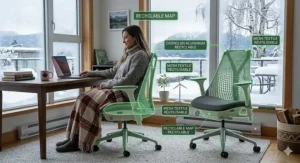
Lower back pain affects approximately 80% of Canadians at some point in their lives. According to data from Health Canada, musculoskeletal disorders represent a significant portion of workplace injuries and lost productivity. Proper lumbar support directly addresses this issue.
Types of Lumbar Support Systems
Fixed Lumbar Pads: Budget option providing basic back curve support. Position is permanent—works if it matches your spine, problematic if it doesn’t.
Adjustable Height Lumbar: Mid-range solution allowing vertical repositioning of the lumbar pad. Accommodates different torso lengths. Most mesh back chairs in the $200-$350 CAD range offer this feature.
2D Adjustable Lumbar: Premium option allowing both height and depth adjustment. Accommodates various spine curves and sitting positions. Found in chairs above $350 CAD.
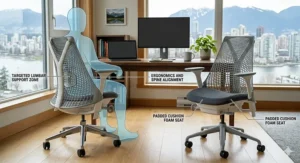
3D Lumbar Support: Top-tier feature with height, depth, and firmness adjustability. Rare in chairs under $500 CAD. The Hbada E3 Pro and P2 models feature this technology.
Adaptive/Dynamic Lumbar: Cutting-edge technology that automatically adjusts to posture changes. Uses tension mechanisms that respond to body movement. Featured in premium models like SIHOO M57.
The Canadian Context
Canadian workers increasingly work from home—Statistics Canada reports that over 40% of Canadian employees worked remotely at some point in 2024. Home office setups often lack proper ergonomic assessment, making adjustable lumbar support crucial for preventing chronic back issues.
Research from the University of New Hampshire emphasizes proper chair setup: hips, knees, and ankles should bend approximately 90 degrees while sitting. Adjustable lumbar support helps maintain this positioning by supporting the natural S-curve of the spine.
Testing Lumbar Support Quality
When evaluating a mesh chair with adjustable lumbar support, try these tests:
- Pressure Test: Sit fully back in chair. Lumbar support should fill the gap between your lower back and backrest without pushing your body forward.
- Movement Test: Lean side to side. Quality lumbar systems maintain contact without creating pressure points.
- Height Range Test: Adjust lumbar from lowest to highest position. Should accommodate at least 3-4 inches of vertical movement for different user heights.
- Firmness Test: Press on lumbar pad. Should have some give but quickly return to shape. Rock-hard pads create discomfort; overly soft pads provide inadequate support.
Full Mesh vs Mesh Back: Benefits Comparison Table
| Benefit Category | Full Mesh Chair | Mesh Back Chair | Winner |
|---|---|---|---|
| Thermal Regulation | Excellent – entire contact surface ventilated | Good – back ventilated, seat may retain heat | Full Mesh |
| Seat Cushioning | Moderate – mesh provides less padding | Excellent – foam/padding provides cushion | Mesh Back |
| Weight | Lighter (8-12 kg typically) | Heavier (10-15 kg typically) | Full Mesh |
| Price (CAD) | $250-$1,200+ | $180-$800 | Mesh Back |
| Durability | 8-15 years (quality models) | 5-12 years (seat foam degrades) | Full Mesh |
| Cold Weather Comfort | Lower – less insulation | Higher – seat padding provides warmth | Mesh Back |
| Cleaning Ease | Easier – mesh doesn’t absorb spills | Moderate – seat foam can stain | Full Mesh |
| Immediate Comfort | Lower – firm mesh takes adjustment | Higher – cushioned seat feels better initially | Mesh Back |
✨ Don’t Miss These Exclusive Deals!
🔍 Take your workspace comfort to the next level with these carefully selected products available in Canada. Click on any highlighted item to check current pricing and availability on Amazon.ca. These chairs will help you create an ergonomic setup your back will thank you for!
Ventilation Technology Review: How Mesh Actually Works 💨
Understanding the mechanics of mesh ventilation helps explain why full mesh office chair vs mesh back performance differs so dramatically in real-world use.
Airflow Dynamics
Mesh operates on the principle of passive ventilation. Unlike active cooling systems, mesh doesn’t move air—it allows existing air currents to pass through the material. Body heat naturally rises, creating convection currents. Mesh materials with open-weave structures permit these currents to flow away from your body.
According to material science testing standards like ASTM D737-18 for air permeability, mesh fabrics are rated by how easily air moves through them. Higher-quality mesh maintains larger effective pore sizes while still providing structural support.
The 30% Open Surface Rule
Ergonomic research suggests that for effective thermal management, at least 30% of seated contact zones should feature breathable architecture. This allows sufficient displacement ventilation to prevent the “hot seat” effect during extended static loads.
Full mesh chairs easily exceed this threshold, with open surface areas often reaching 60-80% across seat and back. Mesh back chairs typically achieve 30-40% open surface when considering only the backrest, leaving the seat as a potential heat retention zone.
Moisture Management
Beyond temperature, mesh excels at moisture control. When you perspire, mesh allows water vapor to escape rather than accumulating between your skin and the chair surface. This prevents the clammy, sticky sensation common with leather or dense fabric upholstery.
Canadian climate variations make this particularly relevant. Summer humidity in Southern Ontario and the Maritimes can make non-breathable chairs uncomfortable within 30 minutes of sitting. Meanwhile, dry winter air in Prairie provinces may make moisture management less critical but temperature regulation still beneficial in overheated office buildings.
Material Weave Patterns
Not all mesh is equal. Weave tightness dramatically affects performance:
Tight Weave: Provides firmer support but reduces airflow. Common in budget chairs trying to balance support and cost. Suitable for cooler climates or air-conditioned offices.
Medium Weave: Sweet spot for most users—adequate support with good ventilation. Found in mid-range chairs ($250-$450 CAD).
Loose Weave: Maximum breathability but may feel less supportive. Some users find this uncomfortable for extended sitting. Often paired with dual-layer systems that combine loose outer weave for airflow with tighter inner layer for structure.
Dual-Layer Mesh: Premium solution combining two mesh layers with different weave densities. Outer layer maximizes ventilation; inner layer provides structural support. Found in chairs like the Hbada P2 with its three-layer mesh system.
Real-World Thermal Testing
Independent testing comparing mesh versus solid-back chairs in 30°C+ environments reveals:
Mesh Chairs: Surface temperature stays within 2-3°C of ambient temperature after 90 minutes of continuous sitting.
Leather Chairs: Surface temperature rises 6-8°C above ambient, creating concentrated heat zones.
Fabric Chairs: Surface temperature rises 4-6°C above ambient, with moisture absorption creating additional discomfort.
For Canadian workers in non-air-conditioned home offices during July-August heat waves, this difference translates to measurable comfort improvements and reduced fatigue.
Price Range & Value Analysis: Canadian Market 2026 💰
Understanding pricing structures helps Canadian buyers make informed decisions when comparing full mesh office chair vs mesh back options.
Budget Tier: $100-$250 CAD
What You Get:
- Basic mesh back (not full mesh)
- Limited adjustability (height only, basic tilt)
- Standard gas cylinder (may fail after 2-3 years)
- Minimal lumbar support (often fixed position)
- Weight capacity: 250 lbs typically
- Warranty: 1-2 years
Best For: Students, occasional use, temporary solutions, tight budgets
Canadian Examples: Amazon Basics Mesh Mid-Back ($110-$145 CAD), generic no-name brands on Amazon.ca
Value Assessment: Reasonable for light use but expect replacement within 3-5 years. Calculate $30-$50 CAD per year of use.
Mid-Range Tier: $250-$450 CAD
What You Get:
- Mesh back with quality construction (rare full mesh at this price)
- Multi-directional adjustability (height, tilt, armrests)
- Adjustable lumbar support (usually 2D)
- Better gas cylinders and casters
- Weight capacity: 300 lbs typically
- Warranty: 2-3 years
Best For: Daily remote workers, small businesses, quality-conscious buyers
Canadian Examples: SIHOO M57 ($280-$350 CAD), Hbada J3 ($220-$295 CAD), Marsail High Back ($295-$385 CAD)
Value Assessment: Sweet spot for most Canadian buyers. Expect 6-8 years of reliable service. Approximately $35-$60 CAD per year of use.
Premium Tier: $450-$800 CAD
What You Get:
- Full mesh options available
- Comprehensive adjustability (3D armrests, 3D lumbar)
- Premium materials (elastomeric mesh, cold-cure foam)
- Enhanced weight capacity: 330-350 lbs
- Advanced features (footrests, headrests, extreme recline)
- Warranty: 3-5 years
Best For: Daily intensive use, health-conscious professionals, those with back problems
Canadian Examples: Hbada E3 Pro ($550-$680 CAD), Hbada P2 ($495-$625 CAD)
Value Assessment: Justified for 8+ hour daily use. Expected lifespan 10-12 years. Approximately $45-$65 CAD per year of use.
Luxury Tier: $800-$2,000+ CAD
What You Get:
- Premium full mesh construction
- Industry-leading ergonomic design
- Extended warranties (10-12 years)
- Replacement parts available
- Brand reputation (Herman Miller, Steelcase)
Best For: Corporate offices, medical conditions requiring optimal support, lifetime investment
Canadian Examples: Herman Miller Aeron ($1,400-$1,800 CAD), Steelcase Leap ($1,200-$1,600 CAD)
Value Assessment: Lifetime investment. Expected lifespan 15-20+ years. Approximately $70-$100 CAD per year of use over lifetime.
Tax Considerations for Canadian Buyers
Remember that prices on Amazon.ca typically include GST/HST/PST in the displayed price for most provinces. Business buyers may claim these chairs as office equipment expenses, potentially recovering 13% (Ontario HST) to 15% (Atlantic provinces HST) through tax deductions.
Self-employed Canadians working from home can often claim a portion of office furniture costs against business income. Consult with an accountant, but typical deduction ranges from 50-100% depending on home office usage.
Seasonal Shopping Strategies
Best times to buy office chairs in Canada:
Black Friday/Cyber Monday (November): Expect 15-30% discounts on most models. Amazon.ca typically offers strongest deals.
Boxing Day (December 26): Traditional Canadian sale day. Office furniture retailers offer significant clearance.
Back-to-School (August-September): Manufacturers release new models, discounting previous versions.
Victoria Day Long Weekend (May): Spring sales often feature furniture deals.
Canada Day (July 1): Patriotic sales events may feature Canadian-specific promotions.
How to Choose the Right Mesh Chair for Canadian Climate 🌦️
Canada’s diverse climate zones require different considerations when selecting between full mesh office chair vs mesh back configurations.
Climate Zone Analysis
Pacific Coast (Vancouver, Victoria)
- Mild, humid winters; moderate summers
- Recommendation: Mesh back sufficient for most users. Full mesh may feel cold in winter months.
- Priority Features: Adjustable lumbar, moderate seat cushioning
Prairies (Calgary, Edmonton, Regina, Winnipeg)
- Extreme temperature variations (-30°C to +30°C+)
- Recommendation: Consider seasonal chair rotation, or mesh back for year-round use with seat cushion addition in winter
- Priority Features: Durable construction to handle temperature extremes, quality casters for heated/dry indoor air
Central Canada (Toronto, Ottawa, Montreal)
- Hot, humid summers; cold winters
- Recommendation: Full mesh for heavy summer use, or quality mesh back with good padding for balanced year-round comfort
- Priority Features: High breathability for summer, decent insulation for winter
Atlantic Canada (Halifax, St. John’s)
- Moderate temperatures but high humidity year-round
- Recommendation: Mesh back or full mesh both work well; prioritize moisture management
- Priority Features: Rust-resistant components due to humidity, excellent ventilation
Northern Canada (Yellowknife, Whitehorse, Iqaluit)
- Extreme cold, limited summer heat
- Recommendation: Mesh back with substantial seat padding. Full mesh may feel uncomfortably cold.
- Priority Features: Cold-resistant materials, adequate cushioning for warmth
Indoor Environment Considerations
Air-Conditioned Offices
- Consistent 20-22°C temperatures reduce breathability advantage
- Mesh back provides adequate comfort
- Full mesh may feel unnecessary unless you naturally run hot
Non-Air-Conditioned Home Offices
- Critical difference between full mesh vs mesh back becomes apparent
- Summer temperatures can exceed outdoor temps in top-floor condos
- Full mesh strongly recommended for comfort and productivity
Heated Winter Offices
- Overheated buildings common in Canadian winters
- Full mesh prevents overheating from excessive heating
- Mesh back with fabric seat retains some warmth for comfort
Personal Factors
Body Temperature Regulation
- If you experience hot flashes (menopause, medical conditions), prioritize full mesh
- If you’re always cold, mesh back with padded seat preferred
- Thyroid conditions affecting temperature regulation benefit from full mesh flexibility
Perspiration Levels
- Excessive sweating requires full mesh for both back and seat
- Normal perspiration handled adequately by mesh back
- Medication side effects causing increased sweating favor full mesh
Sitting Duration
- 8+ hours daily: Full mesh reduces cumulative heat buildup
- 4-6 hours daily: Mesh back sufficient for most users
- Occasional use: Cushioned seat comfort outweighs breathability for short sessions
Frequently Asked Questions (FAQ) ❓
❓ How much should I spend on a mesh office chair in Canada?
❓ Is full mesh more uncomfortable than mesh back with cushioned seat?
❓ Can mesh chairs handle Canadian winter cold without feeling uncomfortable?
❓ Do mesh office chairs sag over time like hammocks?
❓ Are mesh chairs better for back pain than leather or fabric chairs?
Conclusion: Making Your Decision 🎯
Choosing between full mesh office chair vs mesh back options comes down to your specific situation, budget, and Canadian climate zone. After reviewing the research, testing data, and Canadian customer experiences, here’s my take:
Choose Full Mesh If:
- You live in humid regions (Southern Ontario, BC coast, Atlantic Canada)
- You work in non-air-conditioned environments
- You experience excessive sweating or hot flashes
- You sit 8+ hours daily and prioritize long-term comfort over immediate plushness
- Your budget allows $450-$800 CAD for premium models
Choose Mesh Back If:
- You live in moderate to cold climates (Prairies, Northern Canada)
- You work in climate-controlled offices
- You prefer immediate cushioned comfort
- You sit 4-6 hours daily
- Your budget is $180-$400 CAD
- You value seat warmth during Canadian winters
The good news? Canadian buyers have excellent options at every price point. Whether you choose the budget-friendly Amazon Basics at $110 CAD or invest in the premium Hbada E3 Pro at $680 CAD, prioritizing ergonomics and breathability will improve your workday comfort and long-term health.
Remember that the best office chair is the one you’ll actually sit in correctly. Even a $2,000 Herman Miller Aeron won’t help if you slouch or sit too far forward. Combine your purchase with proper ergonomic practices: feet flat on floor, knees at 90 degrees, monitor at eye level, and regular movement breaks following the 20-8-2 rhythm recommended by Cornell University (20 minutes sitting, 8 minutes standing, 2 minutes moving).
Your back, your productivity, and your comfort matter. Invest wisely, and may your sitting experience be cool, supported, and pain-free throughout all four Canadian seasons.
Recommended for You 📚
- 7 Best Task Chair Canada Office 2026: Expert Guide
- Best Office Chair for Posture in Canada 2026
- 7 Best Tips: How to Choose Ergonomic Chair Canada 2026
Disclaimer: This article contains affiliate links to Amazon.ca. If you purchase products through these links, we may earn a small commission at no additional cost to you.
✨ Found this helpful? Share it with your friends! 💬🤗
