
In This Article
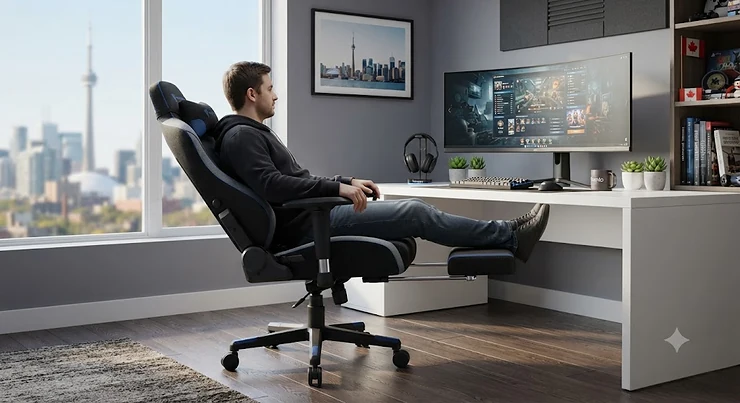
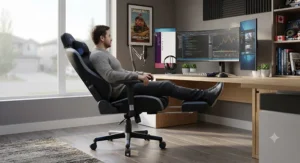
There’s a very specific moment every PC or console gamer eventually hits: round three of a five-round match, your legs are dead-weight under the desk, and you catch yourself eyeing the couch across the room like it’s cheating on you. A gaming chair with retractable footrest exists precisely for that moment. It’s a chair that pulls double duty — locked-in support during the match, and a flat-out recliner the second the match ends — without you ever leaving your seat or your headset.
A gaming chair with retractable footrest is a reclining gaming or office chair with a slide-out (or fold-out) leg rest built into the base, letting you elevate your calves for circulation and rest without swapping chairs. That’s the textbook definition. In practice, it’s the difference between “I need to stand up and stretch” and “I’ll just kick this out for ten minutes.”
This guide is built for a Canadian buyer specifically — CAD pricing ranges, availability on amazon.ca, and a healthy respect for the fact that a lot of us are gaming out of a one-bedroom rental in Toronto or a basement suite in Vancouver, not a dedicated games room. We researched seven real, currently available chairs spanning budget to premium, verified specs and aggregated review sentiment, and cross-referenced ergonomic guidance from the Canadian Centre for Occupational Health and Safety so the advice holds up beyond marketing copy. No invented reviews, no fake hands-on stories — just what the specs, the sourced review patterns, and the numbers actually say.
Quick Comparison Table
| Chair | Recline | Footrest Type | Best For |
|---|---|---|---|
| RESPAWN 110 Pro | 155° | Slide-out, reinforced | All-around comfort and value |
| Homall Gaming Chair | 180° | Slide-out | Budget apartment setups |
| RESPAWN 900 Console Recliner | Fixed recliner | Fold-out, continuous | Console napping, no desk |
| Hinomi H2 Pro | Multi-position | Slide-out, mesh-integrated | Premium ergonomics |
| Dowinx LS-6689 | 90°-145° | Slide-out | Big and tall gamers |
| GTPLAYER Pocket Spring | 90°-155° | Slide-out | Heavy daily use, mesh back |
| WOTSTA | Up to 135° | Slide-out, compact | Tiny apartments |
Looking at the spread here, the split isn’t really “good chair vs. bad chair” — it’s footrest architecture. The RESPAWN 900 trades a slide-out mechanism for a fold-out recliner design, which means no desk clearance needed but also no wheels, so it’s a TV-side chair, not a desk chair. Everything else on this list uses a slide-out drawer under the seat, which is what you want if you’re actually working or gaming at a desk between recline sessions. If floor space is your real constraint, note that the WOTSTA and Homall both keep their maximum recline footprint well under a metre of clearance behind the chair, which matters more than people expect in a Canadian apartment bedroom doubling as an office.
💬 Just one click — help others make better buying decisions too!😊
Top 7 Gaming Chairs With Retractable Footrest: Expert Analysis
We picked these seven to cover the real range of what’s actually sold and shipped in Canada right now — budget, mid-range, premium, and a couple of lesser-known picks that punch above their price tag. Every product name below stays bolded throughout the article so you can scan for the one you’re weighing.
1. RESPAWN 110 Pro — best all-around retractable footrest chair
The RESPAWN 110 Pro earns its “all-around” label by not being the best at any one thing, and that’s actually the point. The reinforced retractable footrest uses multi-point brackets rather than the single hinge you’ll find on cheaper knockoffs, which matters the first time you rest your full leg weight on it instead of just your calves. Dual-density foam layers a softer top over a firmer base, so it doesn’t go flat after eight months the way single-density foam chairs tend to. The 155-degree recline with infinite-position lock means you can stop anywhere in the range rather than being forced into three or four preset notches. It’s rated for roughly 125 kg (275 lb), and the adjustable lumbar pad plus headrest pillow are removable rather than sewn in, which is a small but genuinely useful detail if you like swapping cushion firmness by season.
Based on the spec sheet and aggregated review patterns, this is the chair to buy if you genuinely can’t decide between “gaming chair” and “office chair” — it does both competently without excelling narrowly at either. Reviewers consistently report that assembly takes about 30 minutes with the included Allen wrench and that the footrest mechanism holds up under repeated daily use rather than loosening within the first month, which is the failure point on cheaper alternatives.
Pros:
- ✅ Reinforced multi-point footrest bracket, not a single hinge
- ✅ Dual-density foam resists flattening over time
- ✅ Infinite-lock 155° recline, not just preset notches
Cons:
- ❌ Fixed (non-flip) armrests limit desk-height flexibility
- ❌ Fabric colour options are limited compared to leather trims
Price range: around C$300-C$380 depending on fabric vs. PU leather trim. At this range, it’s a strong value pick precisely because it doesn’t force a trade-off between build quality and footrest reliability.
2. Homall Gaming Chair — most apartment-friendly budget footrest chair
The Homall Gaming Chair is the chair to buy if your primary desk chair is somewhere else and this one is strictly for gaming, guests, or a secondary room. Its headline spec is the 180-degree recline, which goes genuinely flat — not “mostly flat,” actually flat — turning the chair plus extended footrest into something closer to a daybed than a recliner. The massage lumbar pillow runs on a small vibration motor rather than passive foam shaping, which is either a nice-to-have or a gimmick depending on how much you trust vibrating cushions, but it doesn’t get in the way of normal use.
What most buyers overlook about budget chairs in this category is that the compromise usually isn’t comfort, it’s longevity under heavy daily load. Aggregated review sentiment on this model is consistent: it’s an excellent secondary chair for four-hour gaming sessions layered on top of a separate 8-hour office chair, but as a sole daily driver the foam can show compression within six to eight months. If you’re a student or a renter who games in short, intense bursts rather than working from this chair all day, that trade-off barely registers.
Pros:
- ✅ Goes fully flat at 180° — genuine napping recline
- ✅ Compact footprint fits smaller apartment bedrooms
- ✅ Lowest price point of the group by a wide margin
Cons:
- ❌ Foam compression noticeable after 6-8 months of heavy daily use
- ❌ Massage motor feels more novelty than functional
Price range: roughly C$150-C$200, widely available on amazon.ca with Prime shipping. For a secondary gaming chair or a first apartment setup, this is the smart entry point.
3. RESPAWN 900 Console Gaming Recliner — best fold-out design for console napping
Console players sitting on a living room floor cross-legged in front of a TV are exactly who the RESPAWN 900 is built for. It skips wheels and a desk-height gas lift entirely in favour of a continuous fold-out footrest and recliner mechanism — think overstuffed recliner chair with racing-style stitching rather than a repurposed office chair. IGN named it a best buy for its category, and it’s easy to see why once you understand it isn’t trying to be a desk chair at all.
Here’s what the spec sheet won’t tell you outright: because the footrest is fold-out and continuous rather than a slide-out drawer, it’s structurally sturdier under full leg weight, but the chair itself is heavier and effectively immobile once placed. That’s a feature if it’s living permanently beside your TV, and a dealbreaker if you were hoping to roll between a desk and a couch setup. Reviewers who bought it specifically for post-match wind-down naps rate the recline angle and cushioning highly; those expecting desk-chair versatility are consistently disappointed, which tells you this chair rewards buyers who read the “no wheels” spec carefully before ordering.
Pros:
- ✅ Continuous fold-out footrest handles full leg weight reliably
- ✅ Deep recline built specifically for post-match relaxation
- ✅ No desk clearance required — works anywhere with floor space
Cons:
- ❌ No wheels or swivel — effectively a fixed-position chair
- ❌ Bulky footprint, harder to move once assembled
Price range: approximately C$350-C$450. Skip this one if you need a chair that also handles desk work; buy it if console comfort is the entire brief.
4. Hinomi H2 Pro — most ergonomic premium mesh footrest chair
The Hinomi H2 Pro is aimed squarely at buyers who care more about spinal alignment than racing-stripe aesthetics. Full mesh upholstery — rated by the manufacturer for a roughly ten-year lifespan without sagging — replaces the foam-and-leather formula almost every other chair on this list uses, and it stays noticeably cooler over long sessions as a direct result. Depth-adjustable seating, a height-adjustable backrest, flip-up armrests, and a retractable footrest all combine into a chair that reads more like a serious ergonomic office chair that happens to also support gaming posture, rather than the reverse.
Based on the comparison against similarly specced ergonomic chairs, the H2 Pro’s main technical weakness is an optimistic size rating — it’s marketed as fitting a wide height range, but based on the chair’s actual dimensions, users under roughly 163 cm (5’4″) should size down or compare against a petite-frame alternative before buying. That’s a real, sourced caveat worth knowing before you spend premium money on it. For taller or average-height buyers, though, this is the chair to pick if “ergonomics first, gaming aesthetics second” is genuinely your priority.
Pros:
- ✅ Full mesh build stays cool over multi-hour sessions
- ✅ Depth-adjustable seat and independently adjustable backrest
- ✅ Flip-up armrests useful beyond gaming (streaming, instruments)
Cons:
- ❌ Sizing runs large for shorter users despite marketed range
- ❌ Premium price puts it out of reach for casual buyers
Price range: roughly C$700-C$850. This is the “buy once, stop thinking about your chair” pick if your budget stretches that far.
5. Dowinx LS-6689 Big & Tall — best pick for big and tall gamers
Most footrest chairs quietly assume an average frame, and the Dowinx LS-6689 is the corrective. An extra-wide 51 cm (20-inch) seat and a 83 cm (32.5-inch) high back are paired with a genuinely heavy-duty steel frame rated to 181 kg (400 lb), which is a meaningfully different engineering target than the roughly 125 kg most chairs on this list top out at. The extendable footrest and massage lumbar support come standard rather than as an upsell, and the scratch-resistant PU leather with diamond stitching is easy to clean — a real advantage if gaming snacks and drink spills are a fact of life in your setup.
What matters here in practice is weight distribution, not just capacity. A chair rated for 181 kg but built with a narrow seat pan will still feel unstable to a larger user; the LS-6689’s wider base addresses that directly rather than just quoting a bigger number on the box. Reviewers in the big-and-tall category consistently flag assembly as straightforward — under 20 minutes with numbered parts — and note the frame holds up under sustained heavy use better than lighter-framed competitors at a similar price.
Pros:
- ✅ 181 kg (400 lb) rated capacity with a genuinely wide seat pan
- ✅ Scratch-resistant PU leather, easy to wipe clean
- ✅ Standard massage lumbar support, not a paid add-on
Cons:
- ❌ Bulkier footprint takes up more room than standard chairs
- ❌ PU leather runs warmer than fabric or mesh in summer
Price range: around C$280-C$350, which is competitive given the reinforced frame and higher weight rating.
6. GTPLAYER Pocket Spring Cushion — sturdiest frame for heavy daily use
The GTPLAYER Pocket Spring Cushion swaps the usual slab of foam for individually wrapped pocket springs under the seat cushion, the same principle used in higher-end mattresses. The practical upshot: the seat resists the “permanent dent” problem that flat foam chairs develop after a year or two of daily sitting, because springs redistribute load rather than just compressing in one spot. A reinforced frame and mesh-back option round out a chair built explicitly for buyers who sit in it eight-plus hours a day, not just for weekend gaming marathons.
Here’s the honest trade-off reviewers consistently flag: pocket-spring seats feel firmer initially than foam, which some buyers interpret as less comfortable in the first week before their body adjusts. Long-term comfort reports skew positive specifically among heavier daily users who’d previously worn out foam-cushion chairs within a year. If your chair sees genuine full-time use rather than evening sessions, the spring construction is the single spec on this list most likely to extend the chair’s usable life.
Pros:
- ✅ Pocket spring cushion resists permanent seat compression
- ✅ Reinforced frame built for heavy, sustained daily use
- ✅ Mesh-back option improves airflow over straight PU leather
Cons:
- ❌ Firmer initial feel takes an adjustment period
- ❌ Smaller brand footprint means a thinner review pool than Respawn or Dowinx
Price range: roughly C$220-C$280. A smart pick specifically for anyone treating this as their full-time work-and-play chair rather than an evening-only setup.
7. WOTSTA — smallest footprint for tiny apartments
The WOTSTA is the sleeper pick on this list — a smaller, less recognized brand than Respawn or Dowinx, but consistently well-reviewed by Canadian buyers on amazon.ca who found it specifically while searching for compact options. Its standout spec isn’t power or padding, it’s geometry: a maximum recline footprint of around 135 degrees versus the 155-165 degrees common elsewhere, which sounds like a downgrade until you measure the actual floor space behind the chair. In a Toronto condo bedroom or a Vancouver studio where every centimetre is spoken for, that smaller reclined footprint is frequently the deciding factor over a chair with a “better” spec sheet that simply won’t fit.
Three-zone ergonomic support (lumbar, seat, and headrest zones tuned somewhat independently) is a genuinely above-average feature at this price point, and it’s part of why aggregated Canadian reviews for this model skew positive despite the brand’s lower name recognition. The trade-off for buying a newer, smaller company is a thinner track record — fewer years of long-term durability data exist compared to an established name like Respawn.
Pros:
- ✅ Three-zone ergonomic support, genuinely effective for the price
- ✅ Compact recline footprint — ideal for smaller Canadian apartments
- ✅ Strong aggregated reviews from verified Canadian buyers
Cons:
- ❌ Newer brand with a smaller long-term review history
- ❌ Recline maxes out lower than most chairs on this list
Price range: approximately C$130-C$180, making it the most space-efficient option at the budget end of the scale.
Practical Usage Guide: Setup, Maintenance, and Optimization
Getting a gaming chair with retractable footrest right isn’t just about buying one — it’s about how you set it up in the first 30 days. Start by adjusting seat height before anything else: your knees should sit roughly level with or slightly below your hips when both feet are flat on the floor, and only after that’s dialed in should you touch the lumbar or recline settings. A common first-week mistake is cranking the recline to maximum immediately; the footrest mechanism on most slide-out models is rated for calf support, not full leg weight thrust outward at an extreme angle, and pushing it too hard too soon on cheaper hinges is exactly how rails bend.
For maintenance, the footrest track is the part that fails first if neglected. A light silicone-based lubricant (not WD-40, which attracts dust and grime) applied to the slide rails every three to four months keeps the mechanism gliding smoothly and prevents the sticking that eventually strains the bracket. Vacuum the base and caster wheels monthly if you’re on carpet — trapped fibres are the number-one cause of “my chair suddenly won’t swivel” complaints. Rotate cushion positioning if your model has a removable lumbar pad, since consistent one-sided pressure is what causes premature foam compression on one side only.
✨ Don’t Miss These Exclusive Deals!
🔍 Ready to upgrade your setup? Click through to check current pricing and availability on any of these picks before they shift.
Real-World Scenarios: Matching the Chair to Your Situation
The apartment gamer in a studio. If you’re working with a single multi-purpose room — desk, bed, and gaming setup sharing under 30 square metres — recline footprint matters more than raw feature count. The WOTSTA or Homall both keep their extended profile compact enough to avoid clipping a bed frame or wall when fully reclined, which is the single most common regret buyers report after ordering a chair based on specs alone without measuring their actual space.
The console napper. If your setup lives in front of a TV rather than a monitor and desk, and the entire point is post-match wind-down, the RESPAWN 900‘s continuous fold-out design and deep recline outperform slide-out chairs, which are optimized for desk use, not floor-adjacent lounging.
The daily full-time user. If you’re gaming and working from the same chair eight-plus hours a day, durability under sustained load beats novelty features every time. The GTPLAYER Pocket Spring Cushion or the RESPAWN 110 Pro‘s dual-density foam are both built around resisting the compression that ruins cheaper chairs within a year of daily use.
The larger-frame buyer. Standard weight ratings around 125 kg (275 lb) with narrow seat pans genuinely don’t distribute load well for bigger users. The Dowinx LS-6689‘s wider frame and 181 kg (400 lb) rating solve a stability problem, not just a numbers-on-the-box problem.
Retractable Footrest Gaming Chair vs Built-In Footrest Gaming Chair
This is one of the more genuinely confusing distinctions in the category, and it’s worth untangling properly. A retractable footrest gaming chair uses a slide-out drawer mechanism tucked beneath the seat — it’s hidden entirely when not in use, deploys with a pull or a lever, and is standard on the desk-oriented chairs in this guide, including the RESPAWN 110 Pro, Homall, Hinomi H2 Pro, Dowinx LS-6689, GTPLAYER Pocket Spring Cushion, and WOTSTA. A built-in footrest gaming chair, by contrast, typically refers to a continuous fold-out design integrated into the recliner mechanism itself, the way the RESPAWN 900 works — no slide, no drawer, just one continuous reclining motion that unfolds a fixed leg rest.
The practical difference comes down to load-bearing and mobility. Slide-out mechanisms are more compact and let the chair keep its wheels and swivel, but the drawer rails are the weakest structural point and the reason cheaper slide-out chairs eventually fail — putting your full leg weight on the very edge of the extended footrest, rather than distributing it across your calves, is the single most common cause of snapped rails on budget models. Fold-out built-in designs distribute leg weight more evenly across a continuous frame and hold up better under sustained pressure, but sacrifice wheels, swivel, and desk compatibility entirely. If you need a chair that also functions at a desk, retractable wins by default. If the chair’s sole job is recliner-style comfort next to a TV, built-in fold-out designs like the RESPAWN 900 are the sturdier long-term choice.
How to Choose a Gaming Chair With Retractable Footrest
- Confirm your weight against the rated capacity, not just the marketed range. A chair rated near its limit for your body weight will feel unstable well before it visibly fails — buy up a category if you’re near the top of a rating.
- Measure your actual reclined footprint, not just chair dimensions. Add the footrest’s extended length to the backrest’s reclined depth; compare that number against your real floor space before ordering.
- Decide whether you need wheels. If the chair lives at a desk, a slide-out footrest with casters is non-negotiable. If it lives beside a TV, a fixed fold-out recliner like the RESPAWN 900 can be the sturdier choice.
- Check the footrest bracket design, not just “has a footrest.” Multi-point reinforced brackets, like on the RESPAWN 110 Pro, outlast single-hinge designs under repeated full-leg-weight use.
- Match upholstery to your climate and season. PU leather cleans easily but runs warmer; mesh, as on the Hinomi H2 Pro, breathes better for long summer sessions.
- Read aggregated review sentiment for the specific complaint pattern, not just the star rating. A 4.3-star average hides a lot; look specifically for repeated mentions of foam compression timelines or mechanism failures.
- Set a realistic total budget including the “hidden” comfort tax. Ergonomic upgrades like true mesh or pocket-spring cushions add real cost, but as the CCOHS’s guidance on selecting an ergonomic chair notes, a chair only becomes genuinely ergonomic when it’s properly matched to the individual using it — not simply because it’s marketed that way.
Apartment Gaming Setup: Fitting a Footrest Chair Into a Small Space
Canadian apartment living has quietly reshaped what “gaming setup” even means. Toronto condo units have shrunk substantially over the past two decades, and industry reporting on the trend notes some newer downtown builds sit at a fraction of the size that units did a generation ago — which means the era of a dedicated games room with a sprawling recliner setup is, for a lot of renters, simply off the table. A gaming chair with retractable footrest is arguably the single best furniture decision for that reality, because it collapses two pieces of furniture — a desk chair and a recliner or ottoman — into one footprint.
The trick to making it work in a genuinely small apartment gaming setup is planning the reclined position, not just the upright one. Measure from the wall or bed behind your desk to where the fully extended footrest and reclined backrest will land, then subtract a clearance buffer of at least 15 cm. Chairs like the WOTSTA and Homall, with their more compact recline geometry, are specifically suited to this constraint — they sacrifice a few degrees of maximum recline in exchange for meaningfully less floor space consumed, which is exactly the trade-off most apartment gamers should be making.
Compact Furniture Picks That Pair With a Footrest Gaming Chair
A retractable footrest chair does a lot of the space-saving work on its own, but pairing it with genuinely compact furniture around it multiplies the benefit. Look for a corner or L-shaped desk with a shallow depth of 50-60 cm rather than the 76 cm depth common on standard office desks — the shallower footprint gives the reclined chair somewhere to go without hitting furniture behind it. Wall-mounted monitor arms free up desk surface entirely, which matters more in a small room than it sounds, since a cluttered desk surface visually shrinks a space almost as much as physically small furniture does.
Skip bulky under-desk drawer units in favour of slim rolling carts that tuck fully beneath the desk when not in use, and consider a chair mat sized specifically to your chair’s swivel radius rather than a generic rectangular one — it reduces the visual “furniture footprint” of the whole setup by several centimetres on each side, which adds up in a room where you’re measuring floor space in single-digit metres.
Small Room Organization Tips for Gamers
Once the chair and desk are sorted, small room organization for a gaming setup comes down to vertical thinking. Wall-mounted cable management channels keep the notorious rat’s nest of controller, headset, and charging cables off the floor entirely, which matters directly for footrest chairs — a cable snagged under an extended footrest is a genuinely common (and avoidable) tripping and mechanism-jamming hazard. Floating shelves above the desk hold controllers, headsets, and games vertically rather than eating desk or floor real estate.
Consider the chair’s storage compatibility too: some retractable footrest models, including variants of the RESPAWN 110 Pro, sit low enough to allow a slim under-desk shelf behind the extended footrest zone for shoe or slipper storage — a small detail, but one that matters when every surface in a small room needs to justify its footprint. The general rule that consistently pays off: anything that can go on a wall instead of the floor, should.
Gaming Chair With Footrest for Napping: What to Expect
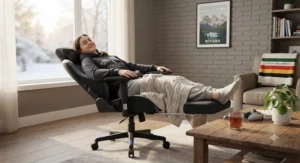
Not every footrest chair is built equally for actual sleep-quality napping, and it’s worth separating “can extend your legs” from “can genuinely rest here.” The deciding factor is recline angle combined with headrest support. A chair topping out around 135-145 degrees, like several slide-out models on this list, elevates your legs but still leaves your torso at a working angle rather than a resting one — fine for a quick break, less so for a real nap. Chairs that push past 155 degrees, and especially the Homall‘s 180-degree flat recline or the RESPAWN 900‘s dedicated recliner geometry, are the ones that actually approximate a bed.
What most buyers overlook here is headrest positioning relative to recline angle — a fixed headrest that sits perfectly at 100 degrees can end up jammed awkwardly against your neck once you recline past 150 degrees. Look specifically for an adjustable or pillow-style headrest, not a fixed molded one, if napping is a genuine use case rather than an afterthought feature on the box.
Common Mistakes When Buying a Gaming Chair With Retractable Footrest
The single most expensive mistake is buying based on maximum weight rating alone without checking seat width — a chair rated for 136 kg (300 lb) with a narrow 43 cm seat pan will still feel unstable for a broader-framed user, because the number on the box measures the frame’s strength, not fit. Close behind that is ignoring recline footprint entirely, which is how buyers end up with a chair that physically can’t recline past 130 degrees in their actual room despite being rated for 155.
A third common error: treating the footrest as rated for full leg weight from day one. Reviewers across nearly every budget model in this category flag the same pattern — the rails are designed primarily for calf support, and repeatedly resting full weight right at the extended edge is the direct cause of premature failure. Finally, skipping the assembly instructions in favour of “I’ve built furniture before” is a specific and recurring complaint pattern in aggregated reviews; footrest mechanisms have a correct bolt-torque sequence, and over-tightening the slide-rail bolts is a documented cause of sticking mechanisms within the first few months.
Safety, Weight Ratings, and Compliance Considerations
Canada doesn’t have a chair-specific consumer safety standard the way it does for, say, children’s furniture, but the closest relevant professional framework is CSA Z412-17, the workplace ergonomics application standard referenced by the Canadian Centre for Occupational Health and Safety. It doesn’t certify individual chairs, but its core principle is directly useful here: no single fixed posture, including a fully reclined one, is correct for extended periods, and alternating between sitting, standing, and reclining positions is consistently recommended over locking into any one position for hours.
On the manufacturer side, weight ratings on these chairs are typically self-certified by the brand rather than independently tested by a third-party Canadian body, which is why aggregated review sentiment — real reports of frames loosening or footrest brackets failing under sustained use — is often more reliable evidence than the number printed on the box. When in doubt, buying one weight tier above your actual body weight is a reasonable, low-cost way to build in a genuine safety margin rather than sitting right at a chair’s rated ceiling every day.
Long-Term Cost and Maintenance
The sticker price on a gaming chair with retractable footrest is only part of the real cost. Budget through mid-range chairs in the C$150-C$350 range typically show foam compression or mechanism wear within one to three years under daily use, meaning the effective annual cost of a C$180 chair replaced every 18 months isn’t actually cheaper than a C$350 chair that lasts five years — it just feels cheaper upfront. Premium picks like the Hinomi H2 Pro front-load the cost but use mesh construction specifically rated to resist the sagging that drives foam-chair replacement cycles, which is the real argument for spending more, not just brand prestige.
Ongoing maintenance costs are genuinely low if you stay ahead of them: occasional silicone lubricant for footrest rails, an annual caster wheel cleaning, and replacement lumbar cushions (typically C$20-C$40 when needed) are the extent of it for most buyers. The costly mistake is deferred maintenance — a sticking footrest mechanism left unlubricated for a year is far more likely to need a full bracket replacement than one maintained on schedule.
Features That Actually Matter (And Those That Don’t)
Recline angle, footrest bracket design, and cushion material (foam density vs. pocket spring vs. mesh) are the three specs that genuinely predict how a chair holds up and feels over years of use — everything else is largely aesthetic. Multi-point footrest brackets, the kind on the RESPAWN 110 Pro, materially outlast single-hinge designs; that’s an engineering difference, not marketing language.
On the other hand, built-in Bluetooth speakers, RGB lighting strips, and “massage” functions running on small vibration motors are the features most likely to be marketing hooks rather than genuine value. They’re not scams exactly — the massage function on the Homall, for instance, does vibrate — but they add cost and points of potential failure without materially improving the chair’s core job, which is supporting your body correctly for hours at a time. If a listing leads with speaker count before recline angle, that’s a reasonable signal about where the manufacturer’s actual engineering priority sat.
Benefits vs Traditional Office Chairs (Without a Footrest)
| Factor | Footrest Gaming Chair | Traditional Office Chair |
|---|---|---|
| Leg circulation on long sessions | Elevated support reduces pressure | No leg elevation option |
| Desk-to-rest transition | Instant, no chair swap needed | Requires moving to a couch/bed |
| Floor space required | Larger reclined footprint | Smaller, consistent footprint |
| Best For | Long gaming/work sessions with breaks | Pure desk work, minimal reclining |
The core trade-off here is space for functionality. A traditional office chair without a footrest takes up meaningfully less floor space and never demands you plan around a reclined position, but it also can’t replace the couch-break function a footrest chair provides. For a Canadian renter with genuinely limited square footage, that trade-off is worth measuring carefully rather than assuming the “better” chair always wins — sometimes the traditional chair is the objectively smarter buy for a cramped studio, even if it’s less exciting on paper.
FAQ
❓ What is the best gaming chair with a retractable footrest in Canada?
❓ Are retractable footrest gaming chairs good for napping?
❓ How much does a gaming chair with a footrest cost in Canada?
❓ Do gaming chairs with footrests fit in small apartments?
❓ What is the weight capacity of a gaming chair with a retractable footrest?
Conclusion
A gaming chair with retractable footrest earns its keep by solving a problem most furniture ignores: the gap between “working at a desk” and “resting nearby,” which usually costs you a second piece of furniture and several square metres you probably don’t have. Across the seven real chairs here, the honest takeaway is that there’s no single universal winner — the RESPAWN 110 Pro is the safest all-around bet, the Dowinx LS-6689 solves a genuine sizing problem for bigger frames, and the WOTSTA or Homall quietly solve the apartment-space problem better than flashier, larger competitors ever could.
What actually separates a good buy from a regretted one isn’t brand recognition — it’s matching footrest architecture, recline footprint, and weight rating honestly to your body, your room, and how you actually use the chair, rather than to whichever spec sheet reads most impressively.
✨ Found the right fit? Check current pricing and availability before you decide — stock and promotions shift often.
Recommended for You
- Gaming Chair With Footrest: 7 Top Picks for Canadian Gamers in 2026
- Best Esports Gaming Chair 2026: 7 Tournament-Ready Picks
- Hybrid Gaming Chair 2026: 7 Best Picks for Work; Play
Disclaimer: This article contains affiliate links. As an Amazon Associate, I earn from qualifying purchases. If you purchase products through these links, we may earn a small commission at no additional cost to you.
✨ Found this helpful? Share it with your friends! 💬🤗
