
In This Article
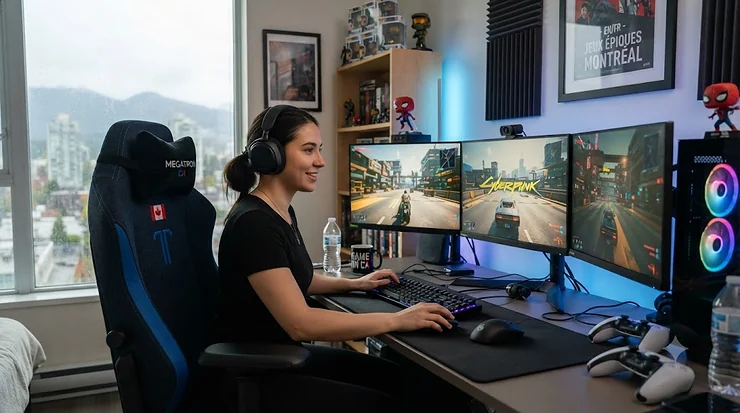
Your back doesn’t care how good your K/D ratio is. It cares about the eight hours you just spent hunched over a keyboard, and a pro gaming chair is the one piece of gear standing between “long grind session” and “chiropractor appointment.” A pro gaming chair is a reinforced-frame seat built with commercial-grade hydraulics, multi-directional armrests and structural lumbar support designed for the marathon sitting sessions of competitive and content-creation gaming — the kind of build quality office chairs half-heartedly borrow from and budget gaming chairs skip entirely.
Here’s the thing nobody tells you before you drop a few hundred dollars on a chair with racing stripes: most of what separates a “gamer” chair from a genuinely durable one has nothing to do with the LED strip or the branded headrest. It comes down to boring engineering — the class of gas lift cylinder inside the base, whether the armrests are steel or hollow plastic, whether the frame is full metal or a mix of metal and reinforced nylon. We dug into the specs, the aggregated reviews, and the actual reasons esports orgs standardize on certain builds so you’re not gambling your lower back on marketing copy.
This guide breaks down seven real, currently available pro gaming chairs — from a sub-C$450 option that punches well above its price to a big-and-tall build rated for 400 lbs — with honest analysis of who each one actually suits. We’ll also dig into what “tournament-grade” construction really means, why 4D armrests matter more than you’d think, and how gas lift cylinder class ratings quietly separate the chairs that last from the ones that sag by month eight. According to the Canadian Centre for Occupational Health and Safety, a chair only counts as ergonomic when it’s matched to your body and your specific task — which is exactly the lens we’re applying here, minus the marketing haze.
Quick Comparison Table
| Chair | Price Range (CAD) | Best For | Standout Feature |
|---|---|---|---|
| Secretlab TITAN Evo | C$700-950 | Best overall / esports-proven | 4-way MagLumbar + 3 sizes |
| AndaSeat Kaiser 4 | C$750-900 | Best challenger to Secretlab | 6D armrests, pop-out lumbar |
| Razer Iskur V2 | C$860-900 | Best dedicated lumbar system | Dual-dial adjustable lumbar |
| Razer Iskur V2 X | C$400-430 | Best budget entry point | Built-in fixed lumbar curve |
| Vertagear PL6800 | C$730-780 | Best for bigger/taller frames | Rated to 400 lbs, 6’8″ |
| noblechairs HERO 2 | C$730-770 | Best minimalist mid-range | German-engineered steel frame |
| Cougar Armor EVO | C$530-570 | Best value tournament build | Class 4 gas lift, aluminum base |
Looking at the spread above, the real story isn’t “which chair is best” — it’s which trade-off you’re willing to live with. The Secretlab TITAN Evo and AndaSeat Kaiser 4 sit at near-identical price points and near-identical build quality, so the decision there mostly comes down to lumbar preference and colourway. The Razer Iskur V2 X and Cougar Armor EVO prove you don’t need to spend C$800+ to get a legitimate Class 4 gas lift and a steel frame; you’re mainly sacrificing armrest sophistication and warranty length. If your frame runs larger than average, the Vertagear PL6800 is the only chair on this list explicitly engineered — not just “accommodating” — for that size range.
✨ Just one click — help others make better buying decisions too! 😊
Top 7 Pro Gaming Chairs: Expert Analysis
1. Secretlab TITAN Evo — the esports tournament standard
The Secretlab TITAN Evo has been the official chair of the League of Legends World Championship since 2019, and that’s not just a sponsorship checkbox — it reflects a design built for consistency across thousands of deployment hours at live events. The chair runs on a Class 4 hydraulic gas piston and a steel frame wrapped in an aluminum-alloy base, with three size options (Small, Regular, XL) covering users from roughly 4’11” to 6’9″ and up to 395 lbs on the XL. What that actually buys you: a chair that doesn’t develop the wobble or sag that cheaper single-size chairs get after a year of daily use.
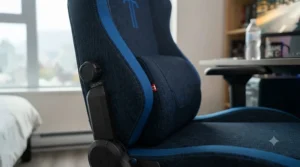
Where the TITAN Evo earns its reputation is the 4-way MagLumbar system — a magnetic lumbar pillow you can slide up or down against a backrest that already has a built-in lumbar curve, layered on top of 4D armrests and 165° of recline. Reviewers consistently describe the piston and recline mechanism as staying tight and rattle-free over years of ownership, a detail that matters more than day-one comfort once you’re past the honeymoon phase with any chair. This one’s for the buyer who wants the “safe pick” — proven at scale, backed by a large owner community, and unlikely to surprise you with a mechanical failure eighteen months in.
Pros:
- ✅ Tournament-proven build with a large, low-failure-rate owner base
- ✅ Three sizes actually fit different body types instead of one-size-marketing
- ✅ MagLumbar and 4D armrests genuinely adjust to your posture
Cons:
- ❌ Napa leather trim and premium fabrics add noticeably to the price
- ❌ Lumbar pillow relies on magnets rather than a structural mechanism
Expect to pay somewhere in the C$700-950 range depending on size and fabric — check current pricing, as Secretlab runs frequent seasonal promotions. For anyone who wants the chair pros are actually sitting in on broadcast, the Secretlab TITAN Evo is the least risky C$800 you’ll spend on your setup.
2. AndaSeat Kaiser 4 — 6D armrests at a lower price than Secretlab
The AndaSeat Kaiser 4 goes toe-to-toe with the TITAN Evo on paper and, according to multiple independent reviewers, on build quality too — while consistently landing at a somewhat lower street price. Its headline feature is the 6D armrest system, meaning six axes of adjustment (rotate, tilt, slide front-back, height, width, and lock), a genuine step up from the 4D standard most competitors offer. The frame is full steel on a one-piece aluminum base, and the SGS-certified Class 4 gas lift is rated for the same demanding, repeated-cycle use as Secretlab’s piston.
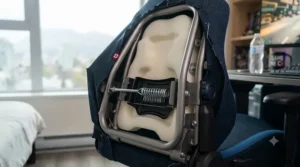
What most buyers overlook about this model is the pop-out lumbar mechanism: pull a lever, lean back, and the lumbar support physically extends to meet your spine at whatever depth you’re sitting — a more mechanical, less “set it and forget it” solution than a magnetic pillow, but one that several reviewers found more precise once dialed in. Aggregated reviewer sentiment consistently flags the PVC leather as softer and less stiff than typical PU alternatives, and the L-size (260 lb capacity) versus XL-size (395 lb capacity) split means sizing actually matters here — check your height and weight against AndaSeat’s chart before ordering.
Pros:
- ✅ 6D armrests offer finer adjustment than most 4D competitors
- ✅ Pop-out lumbar system gives precise, mechanical back support
- ✅ Five-year warranty available (with a straightforward registration step)
Cons:
- ❌ Full five-year warranty requires a social media post to unlock
- ❌ XL size is noticeably heavier and bulkier to move once assembled
Price sits around C$750-900 depending on size and colourway. If the TITAN Evo is the “safe” pick, the AndaSeat Kaiser 4 is the pick for buyers who want marginally more adjustability for a marginally lower price — a genuinely close call between the two.
3. Razer Iskur V2 — the lumbar specialist
Every other chair on this list treats lumbar support as one feature among several. The Razer Iskur V2 treats it as the entire design brief. Two independent dials let you tune both the height and firmness of the lumbar curve separately, a level of precision that Tom’s Hardware and multiple other reviewers rank above Secretlab’s magnetic system and above most office-chair competitors in the same price bracket. The frame is steel with a 5-star aluminum-and-steel base, 4D armrests, and 152° of recline, with a recommended weight limit of 136 kg (about 299 lbs).
Here’s what the spec sheet won’t tell you: reviewers are split on the seat pan, which several found firmer than expected for extended sessions, and the included headrest pillow attaches via a friction-fit strap rather than a solid mount, so it can drift out of position during a long session. Based on the spec comparison, this chair makes the most sense for gamers who already know they have specific lower-back needs and want to fine-tune around them, rather than buyers looking for an all-around comfort chair straight out of the box.
Pros:
- ✅ Dual-dial lumbar system offers the most precise back support tested
- ✅ Solid steel frame with large, smooth-rolling casters
- ✅ Three-year mechanism warranty on moving parts
Cons:
- ❌ Seat cushion runs firmer than most competitors at this price
- ❌ Headrest pillow strap can slip out of position over time
Expect around C$860-900 at the time of research. For anyone who’s dealt with genuine lower-back discomfort in previous chairs, the Razer Iskur V2‘s adjustability is worth the premium over less specialized options.
4. Razer Iskur V2 X — tournament-grade basics without the tournament price
The Razer Iskur V2 X takes the core idea of its pricier sibling — built-in lumbar support — and strips out the expensive dials, delivering a fixed (non-adjustable) lumbar curve at roughly half the price. Construction includes a metal base and steel frame, a genuine upgrade over the all-plastic bases found on entry-level gaming chairs, plus 2D armrests (up and down, with rotation) rather than the full 4D range of the flagship model.
Reviewers consistently note that the fixed lumbar curve takes an adjustment period — it’s noticeably more pronounced than a soft pillow — but that most testers settled into it within the first week and reported genuine relief during long sitting stretches afterward. What most buyers overlook about “budget” chairs in this category is that the failure point is almost always the base and casters, not the cushioning; Razer’s decision to keep a metal base here rather than cutting corners on the frame is the detail that actually justifies calling this chair tournament-grade at a budget price, rather than just “cheap.”
Pros:
- ✅ Metal base and steel frame at a genuine budget price point
- ✅ Built-in lumbar curve delivers real support without extra parts
- ✅ Fast, straightforward assembly reported across reviews
Cons:
- ❌ Lumbar curve is fixed — no adjustment for individual preference
- ❌ Armrests are 2D only, limiting fine positioning versus 4D rivals
Priced around C$400-430, this is the chair to recommend to a teenager building their first serious setup, or anyone who wants tournament-adjacent construction without a tournament-adjacent bill.
5. Vertagear PL6800 — built for bigger and taller frames
Most “one-size-fits-most” gaming chairs quietly assume a fairly average body type, and taller or heavier gamers end up compromising. The Vertagear PL6800 doesn’t make that assumption — it’s rated for users up to 6’8″ and 400 lbs, with a genuinely wider seat pan and taller backrest rather than just a firmer weight rating slapped onto a standard frame. The chair uses Vertagear’s ContourMax lumbar system (four TPEE adaptive modules across 64 responsive branches) alongside a VertaAir seat design intended to reduce pressure buildup during long sits, and a HygenX fabric upholstery with odour-control and antibacterial treatment.
Based on the spec comparison, the ContourMax lumbar takes a genuinely different engineering approach than the magnetic-pillow or fixed-curve systems used elsewhere on this list — it flexes dynamically with your movement rather than holding one shape, which several reviewers found more forgiving over an eight-hour session. The one consistent knock in aggregated feedback: the HygenX fabric, while more breathable than PVC leather, still runs warmer than a full-mesh office chair, so it’s not the pick for someone in a warm room without air conditioning.
Pros:
- ✅ Genuinely sized for 6’8″ / 400 lb frames, not just weight-rated
- ✅ ContourMax lumbar flexes dynamically rather than holding one shape
- ✅ Straightforward “slide-in” assembly system, reviewers report
Cons:
- ❌ Fabric runs warmer than full-mesh alternatives in hot rooms
- ❌ Bulkier footprint may not suit smaller desk setups
Price runs around C$730-780. If you’ve ever felt like a gaming chair was built for someone smaller than you, the Vertagear PL6800 is the option specifically engineered to fix that.
6. noblechairs HERO 2 — steel-frame minimalism from a German engineering house
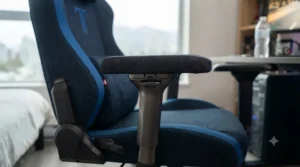
The noblechairs HERO 2 takes a quieter approach than most of this list — no oversized branding, no aggressive racing-seat silhouette — while still delivering the same 4D armrests, integrated lumbar support and a full steel frame you’d expect at this price tier. It’s rated to support up to 330 lbs and ships in eleven upholstery styles, giving it more colour and material flexibility than several competitors here. noblechairs has been building chairs since 2015 and built its reputation in the European market before expanding direct-to-consumer availability in North America.
What most buyers overlook about noblechairs is the warranty gap: at two years, it’s noticeably shorter than the three-to-five-year windows offered by Secretlab, AndaSeat and Razer, which is worth weighing against the otherwise comparable build quality. Aggregated reviewer sentiment describes the HERO 2’s integrated lumbar as effective but less adjustable than dial-based or pop-out systems — a simpler, more “it just works” approach rather than a highly tunable one, which suits buyers who don’t want to fuss with settings.
Pros:
- ✅ Full steel frame and 4D armrests at a competitive price point
- ✅ Eleven upholstery styles offer more design variety than most rivals
- ✅ Understated design fits home-office settings, not just gaming rooms
Cons:
- ❌ Two-year warranty trails most competitors’ three-to-five-year coverage
- ❌ Lumbar support is fixed-effective rather than finely adjustable
Expect around C$730-770 CAD. The noblechairs HERO 2 is the pick for anyone who wants tournament-grade internals without the chair screaming “gaming chair” across a shared home office.
7. Cougar Armor EVO — Class 4 durability on a tighter budget
The Cougar Armor EVO proves that a genuine Class 4 gas lift cylinder and a full steel frame don’t have to cost C$700+. It ships with integrated 4-way lumbar support, a magnetic neck pillow, 180° recline, 4D armrests and a Vortex aluminum-alloy 5-star base with extra-size casters — a spec sheet that reads suspiciously close to chairs costing 40% more. The gas lift cylinder is explicitly marketed as the chair’s core differentiator, and for good reason: it’s the single component most responsible for a gaming chair sagging, tilting unevenly, or failing outright after a year or two of daily cycling.
Here’s what the spec sheet won’t tell you outright: Cougar’s Armor lineup includes several tiers (Armor EVO, Armor Titan Pro, Armor One, Fusion), and the EVO sits in the middle with the most complete feature set of the accessibly priced options — full integrated lumbar and premium foam that the entry-level Armor One and Fusion models skip. Reviewers consistently point to the leatherette surface and breathable PVC as decent-but-not-premium, which tracks with the price positioning: this is a chair built to nail the mechanical fundamentals rather than the upholstery experience.
Pros:
- ✅ Class 4 gas lift cylinder at a notably below-premium price
- ✅ Full steel frame with aluminum-alloy 5-star base and large casters
- ✅ Integrated 4-way lumbar support included standard, no upsell
Cons:
- ❌ PVC leather upholstery feels a step below premium leatherette rivals
- ❌ Smaller review pool than more established competitor brands
Priced around C$530-570, the Cougar Armor EVO is the strongest budget-to-mid pick on this list if your priority is mechanical durability over brand prestige.
Top 7 Products: Detailed Specs Comparison
| Chair | Frame/Base | Armrests | Weight Capacity | Warranty |
|---|---|---|---|---|
| Secretlab TITAN Evo | Steel + aluminum | 4D | Up to 395 lbs (XL) | Up to 5 years |
| AndaSeat Kaiser 4 | Steel + aluminum | 6D | Up to 395 lbs (XL) | 3-5 years |
| Razer Iskur V2 | Steel + aluminum/steel | 4D | Up to 299 lbs | 3 years |
| Razer Iskur V2 X | Steel + metal | 2D | Standard rating | 3 years |
| Vertagear PL6800 | Steel | 4D | Up to 400 lbs | 2 years |
| noblechairs HERO 2 | Steel | 4D | Up to 330 lbs | 2 years |
| Cougar Armor EVO | Steel + aluminum alloy | 4D | Standard-Max tiers | 2-3 years |
The pattern across this table is clear: every chair worth considering in the pro-gaming-chair category runs a steel frame, full stop — if a chair advertises itself as “tournament-grade” but specs out with a nylon or composite frame, that’s a red flag worth walking away from. Warranty length is the other genuine differentiator, and it correlates loosely with brand size rather than build quality; Secretlab and AndaSeat can offer longer coverage partly because their scale absorbs warranty claims more easily than smaller manufacturers. Weight capacity is worth checking against your actual body type rather than assuming — the Vertagear PL6800 and XL configurations of Secretlab and AndaSeat are the only three genuinely built for larger frames on this list.
✨ Don’t Miss These Exclusive Deals!
🔍 Take your gaming setup to the next level with these carefully selected chairs. Click on any highlighted model to check current pricing and availability on amazon.ca. The right chair turns an eight-hour grind session into something your back can actually recover from.
What Chair Do Pro Gamers Use?
The honest answer is less exciting than you’d hope: most professional esports organizations standardize on a small handful of brands, chosen as much for tournament-deployment consistency as raw comfort. Secretlab has held the official chair partnership for the League of Legends World Championship since 2019, meaning the TITAN Evo template — steel frame, aluminum base, integrated lumbar plus a magnetic pillow — has effectively become the default silhouette other manufacturers now copy. That’s less about one chair being objectively superior and more about tournament organizers prioritizing reliability at scale: a chair that performs identically whether it’s the first match of the day or the twentieth deployment of the season.
What’s shifted more recently is that the gap between “official tournament chair” and “everything else” has narrowed. Competitors like AndaSeat and Razer have closed the build-quality distance enough that pro-player preference now comes down more to individual ergonomic fit — lumbar style, armrest range, seat firmness — than brand prestige. If you’re chasing “what the pros use” as a shortcut for quality, it’s a reasonable one; just know you’re paying partly for sponsorship-driven consistency, not necessarily the single best ergonomic fit for your specific body.
Practical Usage Guide: Setup, Break-In, and the First 30 Days
Getting a pro gaming chair right isn’t a one-time assembly job — it’s a two-to-three-week calibration process most buyers skip entirely. Start with base height: your knees should sit at roughly 90-100 degrees with feet flat on the floor, adjusting the chair rather than compensating by hunching toward the desk. Next, dial in the lumbar support empirically rather than by feel on day one — most people set it too aggressive initially and back off after a few sessions once they notice where their natural curve actually sits.
Armrests are the most commonly mis-set component. Set height so your shoulders stay relaxed and your forearms rest level with your keyboard and mouse, not the desk surface — a mistake that quietly causes shoulder strain over months even when the rest of the setup is dialed in correctly. For maintenance: check and re-tighten the base bolts after the first 30 days (they settle with initial use), wipe leatherette or PVC surfaces with a damp microfibre cloth rather than harsh cleaners, and avoid over-reclining against the backstop repeatedly, which is the single fastest way to fatigue a recline mechanism prematurely. Common first-month mistakes include leaving the tilt-lock engaged permanently (defeating the point of a dynamic chair) and never revisiting the initial lumbar setting once the foam or padding compresses slightly with use.
Real-World Scenarios: Matching a Chair to Your Setup
The competitive grinder — six-plus hours daily in ranked queue, small apartment, budget under C$500. This buyer should look hardest at the Razer Iskur V2 X or Cougar Armor EVO: both deliver a genuine steel frame and Class 4-equivalent construction without the premium price tag, and at this usage volume, mechanical reliability matters more than upholstery prestige.
The streamer with a dedicated setup — camera-visible chair, moderate budget, values both comfort and appearance for six-to-ten-hour streams. The Secretlab TITAN Evo or AndaSeat Kaiser 4 make the most sense here: both photograph well on stream, offer size options to match different body types, and their brand recognition doesn’t hurt for viewers who notice gear.
The larger-frame or taller gamer — struggles finding chairs that actually fit, frequently outgrows “one-size” options. The Vertagear PL6800 or the XL configurations of Secretlab and AndaSeat are the only realistic picks; anything else on this list risks the seat pan feeling cramped or the backrest running short within a year.
Common Problems (And the Fixes)
Problem: chair sags or tilts unevenly after a year. This is almost always a gas lift cylinder failing below its rated class — confirm any chair you’re considering explicitly lists Class 3 or Class 4 hydraulics before buying, and avoid unbranded cylinders entirely.
Problem: lower back pain persists despite an “ergonomic” chair. Based on the spec comparison across this list, generic lumbar cushions rarely fix a genuine fit issue — a chair like the Razer Iskur V2, with independently adjustable height and firmness, solves this more reliably than a fixed pillow.
Problem: armrests never sit where you need them. This is a 2D-versus-4D issue more often than a defective unit — chairs like the Cougar Armor EVO or noblechairs HERO 2 with true 4D adjustment solve positioning complaints that plague cheaper 2D-armrest chairs.
Problem: the chair runs hot during long sessions. Fabric and mesh upholstery breathes better than PVC or PU leatherette; if you’re in a warm room without strong air conditioning, prioritize a fabric option like noblechairs HERO 2‘s cloth variants over leatherette-only models.
Problem: chair doesn’t fit a taller or heavier frame. Don’t assume a “270 lb max” spec means comfortable daily use at that weight — treat published max capacity as a hard ceiling, not a target, and size up to the Vertagear PL6800 or an XL configuration instead.
How to Choose a Professional Gaming Chair
- Confirm the gas lift class first. Class 3 or Class 4 hydraulics are the baseline for any chair claiming tournament-grade durability — this single spec predicts long-term reliability better than almost anything else on the listing.
- Match weight capacity with margin, not exactly. If you’re near a chair’s stated maximum, size up rather than assuming the published number is a comfortable daily ceiling.
- Decide how you want lumbar support to work. Fixed curves (like the Iskur V2 X) suit buyers who don’t want to fiddle; dial-based systems (like the Iskur V2) suit buyers with specific back needs.
- Check armrest dimensionality. 4D (or 5D/6D) armrests genuinely reduce shoulder and wrist strain versus fixed or 2D options — don’t treat this as a marketing gimmick.
- Weigh warranty length against brand scale. Longer warranties from larger manufacturers reflect real claims data, not just marketing confidence.
- Consider upholstery for your room’s climate. PVC and PU leatherette feel premium but run warmer; fabric breathes better for hot rooms or poor air circulation.
- Budget for the chair you’ll actually keep for years, not the one that looks best in a single product photo — this is furniture you’ll sit in thousands of hours over its life.
Tournament-Grade Build Quality: What It Actually Means
“Tournament-grade” gets thrown around loosely in gaming chair marketing, but it has a fairly specific engineering meaning when it’s used honestly. It refers to a chair built to withstand repeated, high-cycle use across many different users — the kind of punishment a chair takes at a LAN event or in a shared team facility, where dozens of different bodies sit down, adjust settings, and stand up dozens of times a day for days on end. That’s a meaningfully harder test than a single person’s home office use.
Tournament-grade construction typically means a full steel internal frame (not partial steel with plastic load-bearing points), a Class 4 gas lift cylinder rated for the highest commercial-use cycle count, and a metal — usually aluminum-alloy — five-star base rather than nylon or reinforced plastic. What most buyers overlook about this distinction is that a chair can look identical to a tournament-grade build in photos while cutting corners on exactly these three hidden components, which is why checking the actual spec sheet (not just the marketing page) matters more than the branding on the box.
Adjustable 4D Armrests Explained
4D armrests adjust across four independent axes: height (up/down), width (in/out), depth (forward/back), and pivot (rotating inward or outward). That range matters more than it sounds, because your ideal arm position changes depending on whether you’re using a mouse and keyboard, a controller, or leaning into a headset conversation mid-match. A 2D armrest — height and pivot only — locks you into compensating with your shoulders or wrists for whatever the fixed depth and width happen to be.
Reviewers consistently flag armrest quality as one of the most noticeable differences between a genuinely premium chair and a chair that merely looks premium in photos: full-metal 4D mechanisms (as found on the Secretlab TITAN Evo and Razer Iskur V2) tend to hold position far longer without drifting than hollow-plastic 4D armrests found on budget models that technically check the same feature box. Some newer chairs, like the AndaSeat Kaiser 4, push to 5D or 6D by adding a slide or rotation axis — genuinely useful if you frequently switch between PC, controller and mobile setups, but a marginal gain if you sit in one consistent position for most sessions.
Gas Lift Cylinder Durability: Why the Rating Matters
The gas lift cylinder is the pneumatic piston inside the chair’s base that lets you adjust seat height — and it’s also, mechanically, the component most responsible for how a chair ages. Gas lift cylinders are rated in classes from 1 to 4 under international safety and durability testing standards, with Class 4 representing the highest load and cycle-count rating, generally required for commercial and heavy-duty seating applications. A Class 4 cylinder is engineered to handle both a higher maximum load and a far greater number of height-adjustment cycles before performance degrades.
What the spec sheet won’t tell you outright is how much this one component predicts a chair’s entire lifespan. A chair with an otherwise excellent frame and upholstery, paired with an unrated or Class 2 cylinder, will start sinking, tilting, or bouncing under load well before the rest of the chair shows any wear — and unlike upholstery or foam, a failing cylinder is a safety issue, not just a comfort one. Every chair on this list — from the budget-tier Cougar Armor EVO through the premium Secretlab TITAN Evo — explicitly specifies Class 4 (or SGS-certified equivalent) hydraulics, which is precisely why they made this list over similarly priced competitors that don’t disclose their cylinder rating at all.
Common Mistakes When Buying a Pro Gaming Chair
The single biggest mistake is buying based on aesthetics photographed under studio lighting rather than checking the actual frame material, gas lift class, and weight rating in the fine print. A close second: assuming “gaming chair” automatically means better ergonomics than a well-built office chair — plenty of racing-style gaming chairs prioritize looks over genuine lumbar engineering, while some office-chair-styled models (like noblechairs HERO 2) quietly out-engineer flashier competitors.
Buyers also frequently skip checking recommended height and weight ranges against their own measurements, assuming “one size fits most” applies to them specifically. And a subtler mistake: ignoring warranty terms until after a mechanism fails, when it’s too late to negotiate a better policy — read the actual coverage window and what it excludes (normal wear versus mechanical failure) before, not after, you need it.
Pro Gaming Chair vs Traditional Office Chair
| Factor | Pro Gaming Chair | Traditional Office Chair |
|---|---|---|
| Frame | Full steel, tournament-tested | Steel or reinforced plastic, varies widely |
| Recline | Often 150-165°, built for gaming breaks | Typically 90-135°, task-focused |
| Armrests | 4D-6D standard on premium models | 2D-3D typical, 4D on premium-only lines |
| Aesthetic | Racing/esports styling, bold colours | Neutral, office-appropriate |
| Best For | Long gaming/streaming sessions, tournament use | Mixed desk work, professional office settings |
A deep recline range is the clearest functional distinction here — gaming chairs are engineered for you to lean back between rounds or during a loading screen, something most task-focused office chairs actively discourage through limited recline angles. That said, this isn’t a case where one category strictly beats the other: a well-built ergonomic office chair with strong lumbar engineering (think Herman Miller Aeron-tier) can outperform a mediocre gaming chair for pure desk-work posture, even if it looks nothing like a gaming setup. The honest takeaway is that “gaming chair” versus “office chair” matters less than checking the same fundamentals — frame, gas lift class, lumbar quality — regardless of which aesthetic category the chair falls into.
Long-Term Cost & Maintenance
Run the numbers past the sticker price and the value picture shifts. A C$450 budget chair that needs replacing every 18 months due to a failing cylinder costs roughly C$300 per year of use. A C$800 premium chair backed by a genuine Class 4 cylinder and a 5-year warranty, lasting the full warranty period, works out closer to C$160 per year — cheaper in the long run despite the higher upfront cost. This is the core logic behind spending more on the mechanical fundamentals (frame, cylinder, base) even on a tighter budget, rather than stretching for upholstery upgrades.
Maintenance costs stay low across this entire category if you follow basic care: periodic bolt tightening, avoiding harsh cleaning chemicals on leatherette, and not exceeding the stated weight capacity. Replacement parts — casters, armrest pads, gas cylinders — are available from most of these manufacturers directly, which extends realistic chair lifespan well past the warranty window if a single component eventually wears out rather than the whole unit failing.
Features That Actually Matter (And Those That Don’t)
Actually matters: gas lift cylinder class, frame material (steel versus plastic-reinforced), armrest dimensionality, weight capacity margin, and warranty length relative to brand size. These directly determine how the chair performs in month twelve, not just day one.
Doesn’t matter as much as marketing suggests: RGB lighting kits, embroidered team logos, and cosmetic stitching patterns. These affect how a chair photographs on stream, not how it holds up under daily use — fine to want, but not worth trading away frame quality or gas lift rating to get.
Buyer’s Decision Framework
If your budget is under C$500 and you sit for 4+ hours daily, choose a Class 4 steel-framed budget chair (Iskur V2 X or Cougar Armor EVO) because mechanical durability matters more at high-use volume than premium upholstery. If you have specific lower-back issues, choose a dial-adjustable lumbar chair (Razer Iskur V2) because fixed curves can’t be tuned to an atypical spine shape. If you’re taller than 6’2″ or heavier than 250 lbs, choose a big-and-tall or XL-rated chair (Vertagear PL6800, or XL configurations of Secretlab/AndaSeat) because standard sizing will cramp you within months. If brand consistency and stream aesthetics matter to you, choose the Secretlab TITAN Evo or AndaSeat Kaiser 4 because both balance premium construction with widely recognized styling.
Safety, Regulations and Canadian Standards
Canadian workplace ergonomics guidance from the Canadian Centre for Occupational Health and Safety references the CSA Z412-17 standard for office ergonomics, which recommends alternating between sitting and reclined or semi-standing postures rather than holding one static position for extended periods — a good reminder that even the best pro gaming chair shouldn’t mean sitting motionless for eight straight hours. CCOHS guidance also emphasizes that a chair only functions as genuinely “ergonomic” when it’s matched to the individual’s body dimensions and the specific task, not just because it’s marketed with that label.
While there’s no Canada-specific certification exclusively for gaming chairs, reputable manufacturers typically reference BIFMA (Business and Institutional Furniture Manufacturers Association) testing standards or SGS certification for gas lift cylinders — both of which cover load testing, cycle testing and structural safety. When comparing chairs, treat the presence (or absence) of a stated safety certification for the gas lift cylinder as a genuine buying signal, not fine print to skip past.
Frequently Asked Questions
❓ What chair do pro gamers use?
❓ How much should I spend on a pro gaming chair?
❓ Are gaming chairs actually better for your back than office chairs?
❓ How long should a pro gaming chair last?
❓ What's the difference between 4D and 6D armrests?
Conclusion
The best pro gaming chair for you isn’t necessarily the one broadcast at the last major tournament — it’s the one whose gas lift class, frame material and lumbar style actually match your body and how many hours you realistically sit each day. The Secretlab TITAN Evo and AndaSeat Kaiser 4 remain the safest all-around picks for most buyers, the Razer Iskur V2 solves genuine back-pain problems better than anything else here, and the Cougar Armor EVO and Razer Iskur V2 X prove tournament-grade mechanics don’t require a tournament-grade budget. Whichever you land on, check the current price and availability on amazon.ca before deciding — and remember that in this category, the boring specs (steel frames, Class 4 cylinders, warranty terms) matter far more than the RGB.
Recommended for You
- 7 Best subtle gaming chair Picks for 2026 (Boardroom-Ready)
- Nintendo Switch Gaming Chair: 7 Comfy Picks for 2026
- Tournament Gaming Chair 2026: 7 Picks That Survive Marathon Sessions
Disclaimer: This article contains affiliate links. As an Amazon Associate, I earn from qualifying purchases. If you purchase products through these links, we may earn a small commission at no additional cost to you.
✨ Found this helpful? Share it with your friends! 💬🤗
